
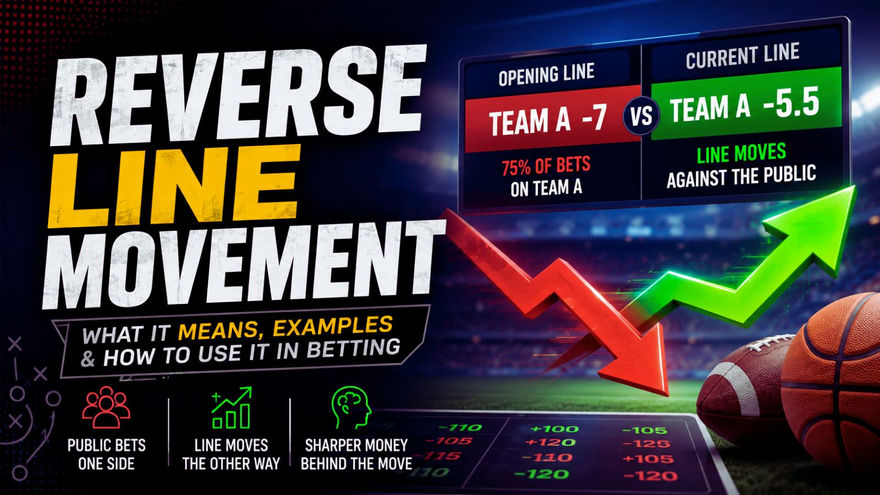
Reverse line movement is when a betting line moves in the opposite direction of where most bets are being placed.
In simple terms, the public may be heavily backing one side, but the sportsbook moves the line toward the other side. That usually means the book is reacting to something stronger than ticket count, such as sharper money, larger wagers, or new market information.
For example, suppose 75% of spread bets are on Team A at -7. Normally, you might expect the line to move to Team A -7.5 or -8. But if the line moves to Team A -6.5 instead, that is reverse line movement.
This matters because reverse line movement can help bettors understand where sharper market opinion may be landing. It is not a guaranteed betting system. It is a signal that tells you where to look more carefully.
Normal Line Movement | Reverse Line Movement |
Line moves toward the popular side | Line moves away from the popular side |
Public bets Team A, Team A becomes a bigger favorite | Public bets Team A, Team A becomes a smaller favorite |
Often reflects public pressure or risk balancing | Often suggests sharper or stronger money on the other side |
Easier for beginners to read | Needs more context before using |
Reverse line movement is often shortened to RLM. You may see both terms in betting guides, odds screens, market reports and betting discussions.
How Betting Lines Move
Before reverse line movement makes sense, you need to understand normal line movement.
A betting line is the number or price offered by a sportsbook. It can appear as a point spread, moneyline, total, handicap or odds price.
For example:
A football team may be listed at -3.5 on the point spread.
A basketball total may be listed at Over/Under 214.5.
A cricket team may be priced at 2.10 in decimal odds.
A football team may be shown as +150 or 2.50, depending on the odds format.
A line can move for several reasons:
Many bettors place money on one side.
A respected bettor places a large wager.
New team news becomes available.
A key player is injured or ruled out.
Weather affects expected scoring.
Another sportsbook moves first, and others follow.
The opening line was too high or too low.
A beginner often assumes that lines move only because most bettors are on one side. That is not always true.
Sportsbooks also care about the quality and size of money, not just the number of bets. A thousand small public bets may not carry as much influence as one large respected bet from a sharp bettor.
This is why it helps to understand the point spread, moneyline bet, and vig or juice. These concepts explain how betting markets are priced, why lines move, and how sportsbooks build margin into odds.
A Simple Normal Line Movement Example
Suppose an NFL game opens like this:
Opening Line | Public Betting |
Dallas Cowboys -3 | 80% of bets on Dallas |
If the sportsbook moves Dallas from -3 to -4, that is normal line movement. The popular side became more expensive because more demand came in on Dallas.
Now compare that with reverse line movement:
Opening Line | Public Betting | Later Line |
Dallas Cowboys -3 | 80% of bets on Dallas | Dallas Cowboys -2.5 |
Here, most bets are on Dallas, but the line moves against Dallas. That is reverse line movement.
The sportsbook is not simply following the public. Something else is influencing the market.
What Causes Reverse Line Movement?
Reverse line movement usually happens when sportsbooks give more weight to sharp money than public money.
A public bettor is usually a casual or recreational bettor. Public bettors often favor popular teams, star players, recent winners, big names and simple narratives.
A sharp bettor is a more respected bettor. Sharps are not always professionals, but they are bettors whose action sportsbooks take seriously because they have shown discipline, strong pricing ability or long-term success.
Reverse line movement can happen when:
The public is heavily betting one side.
Sharper or larger money comes in on the other side.
The sportsbook respects that sharper money.
The line moves toward the sharper side, even though most tickets are on the public side.
That is what creates the “reverse” move.
Bet Count vs Money Bet
One major beginner mistake is confusing bet percentage with money percentage.
Bet percentage tells you how many tickets are on each side.
Money percentage tells you how much money is on each side.
These are not the same thing.
Example:
Side | Number of Bets | Total Money |
Team A | 800 bets | $40,000 |
Team B | 200 bets | $75,000 |
In this example, Team A has 80% of the bets. But Team B has more money.
If the line moves toward Team B, that may look strange at first. But it makes sense if the sportsbook is reacting to bigger or sharper wagers rather than the larger number of tickets.
Why Sportsbooks Respect Sharp Money
Sportsbooks do not treat all betting activity equally.
A respected bettor placing $50,000 on an underdog may matter more than hundreds of small bets on a public favorite. The sportsbook may move the line because it believes the larger or sharper bet carries better information.
That does not mean sharps always win. It means their action can influence the market.
Reverse line movement is often a sign that the sportsbook is reacting to that sharper side.
Other Reasons Lines Can Move
Not every unusual line move is reverse line movement.
A line can also move because of:
Injury news
Team selection changes
Weather
Travel issues
Pitch or court conditions
Market correction after a poor opening number
One major sportsbook moving first
Other books copying that move
So RLM should never be read in isolation. The useful question is: did the line move because of sharp money, or did something else change?
Examples of Reverse Line Movement
Reverse line movement is easier to understand with numbers.
The basic pattern is:
Most bets are on one side.
The line moves toward the other side.
The market may be signalling sharper or stronger money against the public.
Example 1: NFL Point Spread
Suppose the Kansas City Chiefs open as a 7-point favorite against the Indianapolis Colts.
Market Detail | Example |
Opening line | Chiefs -7 |
Public betting | 75% of bets on Chiefs |
Expected move | Chiefs -7.5 or -8 |
Actual move | Chiefs -6 or -5.5 |
Possible sharp side | Colts +7 or better |
Most bettors are backing the Chiefs, but the line moves from Chiefs -7 to Chiefs -5.5.
That means the Chiefs became a smaller favorite even though they were the popular side. This is reverse line movement.
The likely interpretation is that respected money came in on the Colts. The sportsbook adjusted the number toward the Colts despite most tickets being on Kansas City.
Example 2: NBA Total
Suppose an NBA game between Miami and Indiana opens with a total of 208.5.
Market Detail | Example |
Opening total | 208.5 |
Public betting | 80% of bets on Under |
Expected move | Total drops to 207 or lower |
Actual move | Total rises to 211 |
Possible sharp side | Over |
If most bettors are taking the Under, you would normally expect the total to move down.
But if the total rises from 208.5 to 211, the line is moving against the public. That can suggest sharper or larger money on the Over.
Again, it does not guarantee the Over wins. It only shows that the market is not moving with the majority of tickets.
Example 3: Cricket Match Winner Market
Reverse line movement can also apply to cricket, although the term is discussed more often in U.S. sports betting.
Suppose India are playing Australia in a T20 match.
Market Detail | Example |
Opening odds | India 1.80, Australia 2.10 |
Public betting | 70% of bets on India |
Expected move | India shortens to 1.70 or 1.65 |
Actual move | India drifts to 1.95 |
Possible sharp side | Australia |
Most public bettors are backing India. Normally, India’s odds might shorten because of that demand.
But if India move from 1.80 to 1.95, the market is becoming less confident in India even while most bettors are backing them. That is a reverse move.
This could happen because sharper money came in on Australia. It could also happen because of team news, pitch conditions or toss information. That is why cricket bettors should check the context before assuming the move is purely sharp money.
Example Summary
Sport | Public Side | Line/Odds Move | Why It May Be RLM |
NFL | Majority on Chiefs -7 | Chiefs move to -5.5 | Line moves against public favorite |
NBA | Majority on Under 208.5 | Total rises to 211 | Line moves opposite public total bet |
Cricket | Majority on India at 1.80 | India drifts to 1.95 | Public side becomes less attractive |
Football/Soccer | Majority on favorite to win | Favorite odds drift | Market may favor the underdog or draw risk |
These examples show why reverse line movement is not just about counting bets. It is about comparing public betting data with the actual market move.
Why Reverse Line Movement Matters
Reverse line movement matters because it can reveal a gap between public opinion and sharper market opinion.
Public bettors often react to obvious factors:
Bigger team name
Recent winning streak
Star player narrative
Media coverage
Home advantage
Emotional bias
Sharp bettors usually care more about price and value. They may back an unpopular side if they believe the odds are wrong.
That is why RLM can be useful. It may show that the sportsbook is respecting money on the less popular side.
RLM Can Help You Understand the Market
Reverse line movement helps answer practical questions:
Is the public heavily on one side?
Is the sportsbook moving against that side?
Is sharper money likely on the other side?
Has the value already disappeared?
Is the move caused by betting action or news?
A bettor who understands these questions reads the market more carefully than someone who only follows public percentages.
But It Is Not a Guaranteed Edge
Reverse line movement does not mean “bet the other side automatically.”
There are several reasons:
The line may have already moved too far.
Public betting data may be incomplete.
The move may be caused by injury news.
The sportsbook may be copying another book.
Sharps may have liked the earlier number, not the current number.
Some moves may be misleading.
For example, if sharps backed an underdog at +7, that does not mean the same side is still valuable at +5.5. By the time you notice the RLM, the best price may already be gone.
That is why RLM should be treated as information, not instruction.
How to Track & Use Reverse Line Movement
To track reverse line movement, compare the opening line, current line and public betting percentages.
You are looking for a mismatch between public action and line direction.
Step-by-Step Process
Check the opening lineNote where the market started. This gives you the baseline.
Check the current lineLook at where the number has moved.
Check public betting percentagesSee which side has the majority of tickets.
Compare the directionIf the line moves against the side with most bets, that may be reverse line movement.
Check for newsLook for injuries, team changes, weather, pitch conditions or other updates.
Compare multiple sportsbooksOne sportsbook may move faster than another. A single-book move is weaker evidence than a market-wide move.
Ask whether value remainsDo not bet only because the line moved. Ask whether the current price is still worth taking.
Simple Tracking Table
What to Check | Why It Matters |
Opening line | Shows where the market started |
Current line | Shows the direction of movement |
Bet percentage | Shows public ticket count |
Money percentage | Shows where larger money may be |
Injury/news updates | Explains non-betting movement |
Multiple books | Confirms whether the move is market-wide |
Current price | Helps avoid chasing bad numbers |
Avoid Chasing Steam
“Chasing steam” means reacting late to a fast line move because you assume sharp bettors caused it.
This is risky.
By the time you see the move, the good number may already be gone. A sharp bettor may have taken +7, but you may only be getting +5.5. That difference can matter a lot, especially in spread betting.
The better approach is to use reverse line movement as one part of your process. Combine it with pricing, matchup analysis, team news and bankroll management.
Pros and Cons of Following Reverse Line Movement
Reverse line movement can be useful, but it has clear limits.
It should help you ask better questions. It should not replace your own analysis.
Pros | Cons |
Can reveal possible sharp money | Public data can be incomplete |
Helps spot unpopular market sides | Value may be gone after the move |
Useful for reading line movement | Can be confused with injury or news moves |
Helps avoid blindly following the public | Can lead to steam chasing |
Works across spreads, totals and odds markets | Some moves may be misleading or manipulated |
Benefits of RLM
Reverse line movement can help bettors see where the market may be stronger than the public appears to be.
It can also stop you from making a lazy public-side bet. If 80% of bets are on a favorite but the line is moving against that favorite, that is a signal to slow down and look deeper.
RLM can also point you toward possible value bet opportunities. The point is not simply “follow the sharp side.” The better question is whether the current price is still better than the true probability.
Risks of RLM
The biggest risk is treating reverse line movement like a shortcut.
RLM does not tell you everything. It does not tell you the exact reason for the move. It does not tell you whether the current number still has value. It does not guarantee that the side with sharp money will win.
It can also be confused with arbitrage betting, but the two are different. Arbitrage is about locking in price differences across outcomes. Reverse line movement is about interpreting market movement.
Dummy Moves
A dummy move is when sharp bettors appear to push a line one way before betting the other side later.
For example, a sharp group might bet a favorite early to move the spread from -3.5 to -4.5. Then, once the underdog becomes more attractive at +4.5, they come back and bet the underdog.
Beginners who follow the first move may end up on the wrong side at a poor number.
This is another reason not to follow RLM blindly.
Reverse Line Movement vs Steam Moves & Other Line Indicators
Reverse line movement is often confused with steam moves, regular line movement and injury-driven movement.
They are related, but not the same.
Term | Meaning |
Reverse line movement | Line moves opposite to the side receiving most bets |
Steam move | A fast market-wide move, often caused by sharp action |
Regular line movement | Line moves because of betting demand or market adjustment |
Injury/news movement | Line moves because new information changes the price |
Dummy move | A misleading move that may be used to shape the market |
Reverse Line Movement vs Steam
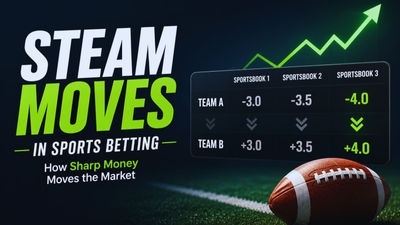
A steam move is a sudden, sharp line move across multiple sportsbooks.
It may happen because respected bettors hit the same side quickly, causing books to react.
Reverse line movement is more specific. It requires a contrast between public betting and the line move.
Example:
If a line moves quickly from -3 to -5 across the market, that may be steam.
If 80% of public bets are on Team A but the line moves toward Team B, that is reverse line movement.
A move can be both steam and reverse line movement, but it is not always both.
Not Every Strange Move Is RLM
A line may move against public bets because a star player is ruled out. That is not necessarily reverse line movement caused by sharp money.
A cricket market may move after toss news. A football market may move after a key lineup announcement. A basketball total may move after pace or injury news.
Before calling any move RLM, check whether there is a clear non-betting reason.
Global & Regional Considerations
Reverse line movement is most commonly discussed in U.S. sports betting, especially NFL, NBA, MLB and college sports.
That is mainly because U.S. betting markets often publish public betting splits, spread movement and market-wide odds changes in a way that makes RLM easier to track.
But the concept can apply anywhere a betting line moves.
US
In the US, RLM is often discussed around point spreads and totals.
For example:
NFL spread moves
NBA totals
College basketball underdogs
MLB moneylines
Because different states and sportsbooks may offer different prices, U.S. bettors often compare multiple books. That helps them see whether a move is real market movement or just one book adjusting.
UK
UK bettors may see reverse line movement through football odds, horse racing markets or exchange movement.
The term itself is more U.S.-centric, but the idea applies to decimal odds too.
For example, if most casual bettors back a popular football club at 1.80, but the price drifts to 1.95, that may suggest the market is cooling on that favorite.
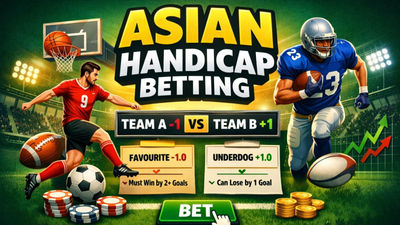
RLM can also appear in football handicap markets, where a team may move from -1.0 to -0.75 even while attracting public support. If you want to understand how handicap-style lines work, TBP’s guide to handicap bets is useful background.
India
In India, cricket is the most natural example.
A team like India may attract heavy public betting because of popularity. If the odds move against India despite that public interest, it may suggest sharper money, market correction or new information such as toss, pitch conditions or team selection.
Indian users should also be careful with legal and regulatory restrictions. Betting laws vary by region and platform. The safest approach is to understand the concept educationally and check local rules before using any betting product.
Responsible Betting & Final Thoughts
Reverse line movement means the betting line is moving against the side receiving most public bets.
It can be a useful clue. It may suggest sharper money, stronger money or a market correction. It can also help you avoid blindly following the public.
But it is not a magic formula.
The key lesson is this: RLM tells you where to investigate, not what to bet.
Before acting on reverse line movement, check the opening line, current line, public bet percentage, money percentage, injuries, weather, team news and whether the current number still has value.
A bettor who understands RLM is reading the market more carefully. A bettor who blindly follows RLM is still guessing.
Use reverse line movement as one tool, keep stakes disciplined, and rely on proper bankroll management rather than chasing every move.
FAQs
What is reverse line movement?
Reverse line movement is when a betting line moves opposite to the side receiving most bets. For example, if most bettors back a favorite but the line moves toward the underdog, that is reverse line movement.
Why does reverse line movement happen?
Reverse line movement usually happens when sharper or larger money comes in on the less popular side. Sportsbooks may respect that money more than the number of public tickets and move the line accordingly.
Is reverse line movement a good betting strategy?
Reverse line movement can be useful, but it is not a complete betting strategy by itself. It may point to sharp money, but the value may already be gone by the time the line has moved.
How can I track reverse line movement?
You can track reverse line movement by comparing the opening line, current line and public betting percentages. If most bets are on one side but the line moves the other way, that may be RLM.
What is the difference between reverse line movement and steam?
Reverse line movement is a line move against public betting percentages. A steam move is a fast market-wide line move, usually caused by sharp action or sudden market pressure.
Does reverse line movement apply to cricket or football?
Yes, reverse line movement can apply to cricket or football if the odds move against the side receiving most public bets. It is more commonly discussed in U.S. sports, but the market logic is not limited to the US.
Why do sportsbooks care about sharp money?
Sportsbooks care about sharp money because respected bettors may have stronger information, better models or long-term winning records. A large sharp bet can move a line even if most public bets are on the other side.
Can reverse line movement be manipulated?
Yes, some line movement can be misleading. Sharp bettors may create dummy moves, or a line may move because of injuries, weather or team news rather than genuine sharp money.