
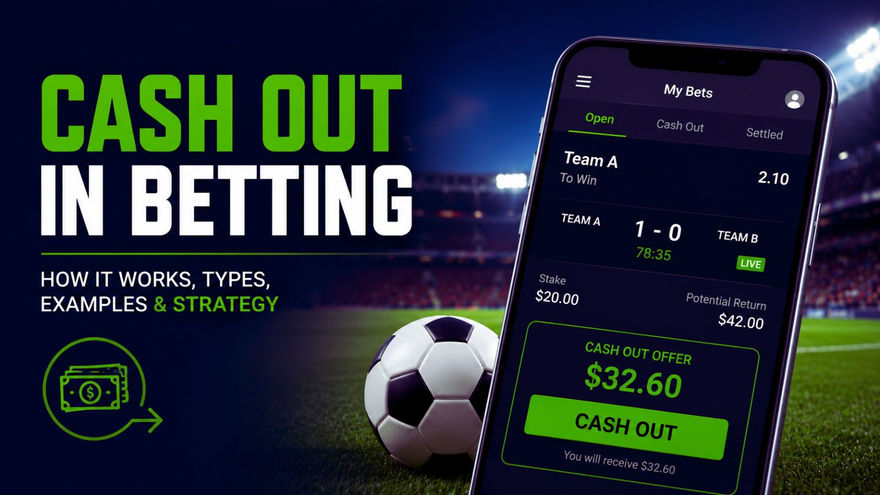
A cash out option in betting lets you settle an active bet before the event finishes. Instead of waiting for the final result, the sportsbook offers you a payout based on the current value of your bet.
If your bet is going well, cash out can help you lock in a smaller profit. If your bet is going badly, it can help you recover part of your stake instead of losing the full amount.
Cash out is also known as early settlement or buy-out betting. It is most common on online and mobile betting apps, especially for live betting, football accumulators, basketball games, cricket matches, and some futures bets.
The key point is simple: cash out gives you more control, but usually at a cost. The offer is normally lower than the full amount you would receive if the bet won naturally.
Normal Bet Settlement | Cash Out Settlement |
You wait until the event ends | You settle before the event ends |
You win or lose based on the final result | You accept the sportsbook’s current offer |
Full payout if the bet wins | Usually lower than the full potential payout |
No decision needed after placing the bet | You decide whether the offer is worth taking |
Cash out is not a guaranteed profit tool. It is a risk-management feature. Used well, it can reduce uncertainty. Used badly, it can cut into returns and encourage emotional betting.
How Does Cash Out Work?
Cash out works by letting you close an active bet early for the amount currently offered by the sportsbook.
The usual process looks like this:
You place a bet.
The bet remains active while the event is still undecided.
The sportsbook calculates a live cash-out value.
You see the offer in your active bets or “My Bets” section.
You choose whether to accept or ignore it.
If you accept, the bet is settled immediately.
The final match result no longer affects your payout.
For example, suppose you place a $20 bet on a football team to return $60. Your team is leading 1-0 with 10 minutes left. The sportsbook may offer you $45 to cash out.
If you accept, you receive $45 and the bet ends. If your team later concedes and the match finishes 1-1, it does not matter because your bet has already been settled.
But if your team holds on and wins, you do not receive the full $60. You only keep the $45 you accepted.
Cash out usually appears as a button beside an eligible bet. Some sportsbooks ask you to confirm the offer before it is accepted because the value can change quickly.
Not every bet is eligible. Cash out can also disappear during key moments such as a goal, wicket, penalty, injury, timeout, or market suspension.
The beginner rule is this: a cash-out offer is temporary, not guaranteed.
Types of Cash Out
Sportsbooks may offer different types of cash out. The three main types are full cash out, partial cash out, and auto cash out.
Type | Meaning | Simple Example |
Full cash out | You close the entire bet early | You accept $40 now instead of waiting for a possible $70 payout |
Partial cash out | You settle part of the bet and leave the rest active | You cash out half your stake and let the remaining half continue |
Auto cash out | You set a target amount, and the bet settles automatically if that value is reached | You set auto cash out at $50, and the system settles the bet if the offer reaches $50 |
Full Cash Out
Full cash out closes the entire bet.
Once you accept the offer, the bet is finished. You cannot return to the original bet later, even if the final result goes in your favour.
Example:
You stake $10 on a basketball team with a possible return of $35. Your team is leading in the fourth quarter, and the sportsbook offers $24 to cash out.
If you accept $24, you lock in a profit. But you also give up the chance to receive the full $35.
Partial Cash Out
Partial cash out lets you settle only part of your bet.
This can be useful when you want to reduce risk but still keep some upside. It is commonly used on accumulators, parlays, and multi-leg bets.
Example:
You place a $10 football accumulator with a possible return of $100. Two selections have won, and one match remains. The sportsbook offers a partial cash out.
You might cash out half of your stake and leave the other half active. This means you secure part of the return while still keeping a chance at a larger payout.
Partial cash out is a middle-ground option. It does not remove all risk, but it can reduce exposure.
Auto Cash Out
Auto cash out lets you set a target cash-out value in advance.
If the sportsbook offer reaches that value, your bet is automatically settled. This can be helpful if you cannot watch the match live or if you want to avoid making a rushed decision during the event.
Example:
You place a $20 cricket bet and set auto cash out at $38. If your cash-out value reaches $38 during the match, the sportsbook settles the bet automatically.
The downside is that the bet may keep improving after that. You may secure profit, but you could also miss out on a larger return.
Factors That Affect Cash-Out Offers
Cash-out values change because the sportsbook is constantly recalculating the current value of your bet.
The offer usually depends on:
Your original stake
The odds you took when placing the bet
The current odds
The score or match situation
Time remaining
Number of selections still open
Injuries, weather, team news, or in-play events
The sportsbook’s margin
A simple way to understand it is:
Cash-out value = current estimated value of the bet minus sportsbook margin
This is not an exact public formula because sportsbooks use their own models. But the idea is easy to follow.
If your bet is more likely to win now than when you placed it, the cash-out offer usually rises. If your bet is less likely to win, the offer usually falls.
Situation | Likely Cash-Out Effect |
Your team scores early | Cash-out value rises |
Your team concedes | Cash-out value falls |
Time is running out and your bet is winning | Cash-out value rises |
One leg of a parlay loses | Cash out may disappear |
Odds move strongly against your selection | Cash-out value falls |
Market is suspended after a goal or wicket | Cash out may be temporarily unavailable |
Cash-out offers also include the sportsbook’s margin, often called vig or juice. That is one reason the offer may feel lower than what you think the bet is worth.
This is also where the idea of a value bet matters. A cash-out offer is not automatically good just because it gives you money now. The real question is whether the offer is fair compared with the true chance of your bet winning.
Examples Across Sports
Cash out is easiest to understand through simple betting situations.
Football Accumulator Example
Suppose you place a $10 accumulator on three football teams.
Bet Detail | Value |
Stake | $10 |
Potential payout | $80 |
First two selections | Won |
Final selection | Team A to win |
Cash-out offer before final match | $32 |
You now have a choice.
You can cash out for $32 and take a guaranteed profit. Or you can let the bet run and hope Team A wins, which would return $80.
Decision | Result |
Cash out | You receive $32 regardless of the final match |
Let it ride and Team A wins | You receive $80 |
Let it ride and Team A loses or draws | You receive $0 |
This is the classic cash-out decision. The safer option gives you less. The higher-risk option keeps the full payout alive but can also return nothing.
NBA Single Bet Example
Suppose you bet $25 on the Boston Celtics to win, with a possible return of $45.
At halftime, the Celtics are leading by 12 points. The sportsbook offers you $36 to cash out.
Bet Detail | Value |
Stake | $25 |
Potential return | $45 |
Cash-out offer | $36 |
Current situation | Celtics leading at halftime |
If you cash out, you lock in $36. If you let the bet ride and the Celtics win, you receive $45. If they collapse in the second half, you lose the bet.
The cash out option reduces risk, but it also reduces your maximum return.
Cricket Match Example
Suppose you stake $20 on India to beat Australia in a T20 match. The possible return is $42.
India start well and reach 80/1 after 8 overs. Your cash-out offer rises to $33. Later, if India lose two quick wickets, that offer might fall to $18 or disappear temporarily.
Match Situation | Possible Cash-Out Offer |
India 80/1 after 8 overs | $33 |
India lose two quick wickets | $18 |
Australia become favourites | Offer may drop further |
Market suspended after a wicket | Cash out may be unavailable |
This is why cash-out values can move quickly in cricket. Wickets, run rate, pitch conditions, toss impact, and match momentum can all affect the offer.
Pros and Cons of Cash Out
Cash out can be useful, but it always involves a trade-off.
Pros | Cons |
Lets you lock in profit early | Reduces your full potential payout |
Helps reduce losses on a bad bet | The offer usually includes sportsbook margin |
Useful for long parlays or accumulators | Can encourage emotional decisions |
Gives more control during live betting | Not available on every market |
Can protect part of a winning position | Frequent use can reduce long-term returns |
Benefits of Cash Out
Cash out can make sense when the situation has changed.
For example, if a key player is injured, weather conditions shift sharply, or your final parlay leg looks weaker than expected, cashing out may be reasonable.
It can also help when the amount involved is meaningful to your bankroll. A bettor with a small bankroll may prefer a guaranteed $150 over risking everything for $220.
Cash out can also reduce pressure for beginners. Waiting for the last leg of a parlay can be stressful. Taking a smaller guaranteed amount may be the right decision if the alternative would push you into reckless betting.
Drawbacks of Cash Out
The main drawback is value.
Sportsbooks do not offer cash out for free. The offer usually protects the book’s position and includes margin. That means the cash-out amount is often lower than the fair value of the bet.
For example, if your bet has a realistic current value of $60, the sportsbook may offer $52 to cash out. You get certainty, but you pay for that certainty through a lower payout.
Another drawback is regret. If you cash out early and your original bet wins, you may feel you left money on the table.
That is why cash out should be used as a tool, not a habit.
Cash Out vs Hedging & Arbitrage
Cash out is often compared with hedging and arbitrage betting, but they are not the same thing.
Method | How It Works | Main Difference |
Cash out | You accept the sportsbook’s offer to settle early | Simple, but the book controls the price |
Hedging | You place a second bet on another outcome to reduce risk | More control, but requires another bet |
Arbitrage | You bet all outcomes at different odds to lock in profit | More advanced and depends on price differences |
Cash Out vs Hedging
Cash out is built into the sportsbook. You click a button, accept the offer, and the original bet ends.
Hedging means placing another bet to reduce risk. For example, if you have a parlay with one football match left, you might bet on the opposite outcome to guarantee some profit whichever side wins.
Cash out is easier. Hedging can sometimes produce better value, but it requires more calculation and access to suitable odds.
Cash Out vs Arbitrage
Arbitrage betting is different again. It involves placing bets on all possible outcomes at different prices to create a locked-in profit.
Cash out is not arbitrage. It is an early settlement feature. It may reduce risk, but it does not automatically create positive value.
For beginners, the key difference is simple: cash out is offered by the sportsbook; hedging and arbitrage require you to make extra betting decisions.
Regional & Legal Considerations
Cash out works in a similar way across markets, but availability and legality vary by country, sportsbook, sport, and bet type.
Region | Cash-Out Notes |
US | Available on select regulated sportsbook apps. Not all markets support it, and offers may include extra vig. |
UK | Widely available through licensed bookmakers, especially on football, racing, accumulators, and live markets. |
India | Betting laws vary and can be restrictive. Cash out may appear on offshore platforms, but users should check local rules before betting. |
Global | Availability depends on the sportsbook, sport, market, and current event situation. |
US
In the US, cash out is mainly an online and mobile sportsbook feature. It may be available for moneyline bets, point spreads, totals, parlays, and futures, depending on the operator.
A moneyline bet or point spread can both receive cash-out offers, but the value depends on current odds and the live game state.
US bettors should be especially careful about offer value because cash out often includes extra margin.
UK
In the UK, cash out is widely used on football, horse racing, cricket, and accumulators. Many bookmakers also offer partial cash out and auto cash out.
UK bettors are often familiar with the feature, but the same caution applies: convenience does not always mean value.
India
For Indian readers, cricket is the most natural cash-out example. A cash-out offer may rise or fall quickly after wickets, partnerships, toss decisions, or pitch changes.
Betting laws in India vary by state and can be restrictive. Users should check local rules and only use platforms that are legal and permitted where they live.
Responsible Use & Bankroll Tips
Cash out is useful only when it supports disciplined betting. It should not become a panic button.
A few practical rules help:
Know your stake before placing the betYour stake is the amount you risk. Do not stake more than you are comfortable losing just because you think you can cash out later.
Do not cash out only because of fearA close game is not always a reason to cash out. Ask whether the offer is fair, not just whether you feel nervous.
Compare the offer with the full payoutIf the full payout is $100 and the cash-out offer is $72, decide whether the certainty is worth giving up $28.
Use bankroll disciplineGood bankroll management matters more than any single cash-out decision.
Avoid chasing lossesCashing out a losing bet to place another bet immediately is not a strategy. It can lead to rushed decisions and larger losses.
The best way to think about cash out is simple: it gives you flexibility, not an edge by itself.
Conclusion & Key Takeaways
A cash out option in betting lets you settle an active bet before the event ends. It can help you lock in profit, cut losses, or reduce pressure during live betting.
But cash out usually comes at a price. The sportsbook controls the offer, and the payout is often lower than the fair value of the bet.
Use cash out when it fits your plan, not because of panic. Check the offer, compare it with the full potential return, consider alternatives like hedging, and keep your bankroll in mind.
The main lesson is this: cash out is a risk-management tool, not a guaranteed way to make better bets.
FAQs
What does cash out mean in betting?
Cash out means settling your bet before the event finishes for a value offered by the sportsbook. You accept that amount instead of waiting for the final result.
How do I cash out a bet?
To cash out a bet, open your active bets section, check whether a cash-out offer is available, review the amount, and confirm if you want to accept it. Once confirmed, the bet is settled.
Is it better to cash out or let a bet ride?
It depends on the offer and your risk tolerance. Cash out gives you certainty, but letting the bet ride gives you the chance to receive the full payout if it wins.
What is partial cash out?
Partial cash out means settling part of your bet early while leaving the rest active. It can help you lock in some return while still keeping a chance at a larger payout.
Does cash out include extra vig or juice?
Yes, cash-out offers usually include the sportsbook’s margin. That means the offer may be lower than the true current value of your bet.
Can you cash out a free bet?
Some sportsbooks do not allow cash out on free bets or promotional bets. Rules vary by operator, so always check the terms before placing the bet.
What sports can I cash out on?
Cash out is commonly available on football, basketball, cricket, tennis, horse racing, and other major sports. Availability depends on the sportsbook, market, and current event situation.
Is cash out legal in India?
Cash out legality depends on whether the underlying betting activity is legal in your location. Betting laws in India vary by state, so users should check local rules before using any betting feature.
Is auto cash out safe?
Auto cash out can be useful for discipline, but it can also settle your bet before the market moves further in your favour. Use it only when you are comfortable with the target amount you set.