
Introduction: Reverse Bets in a Nutshell
A reverse bet is a sports bet made from two conditional if-bets running in opposite directions.
Instead of placing only one sequence like:
If Selection A wins, then bet on Selection B.
A reverse bet also adds the opposite sequence:
If Selection B wins, then bet on Selection A.
That means both orders are covered at the same time. The trade-off is cost: a reverse bet usually costs twice as much as a single if-bet because you are placing both conditional sequences.
Reverse bets are useful to understand if you are learning about multi-leg betting, parlays, if-bets, round robins, or conditional wagers. They are not a beginner “must-use” bet. They are more advanced, less common, and need careful bankroll control.
Here is the quick comparison:
Bet Type | Simple Meaning | Main Risk |
Straight bet | One bet on one outcome | You win or lose that single bet |
Parlay | Multiple selections combined into one bet | One losing leg usually kills the whole ticket |
If-bet | Second bet activates only if the first bet wins, pushes, or is cancelled | Order matters |
Reverse bet | Two if-bets placed in both directions | Costs more because both sequences are active |
This guide explains how reverse bets work, how they compare to parlays and if-bets, what an action reverse bet means, and when this type of wager may or may not make sense.
How If-Bets Work
Before you can understand a reverse bet, you need to understand an if-bet.
An if-bet is a conditional bet. The second wager is only placed if the first wager wins, pushes, or is cancelled, depending on the sportsbook’s rules.
Example:
You bet $50 on Team A.
If Team A wins, your $50 bet on Team B activates.
If Team A loses, the Team B bet is never placed.
That is why it is called an if-bet. The next bet only happens if the first condition is met.
This is different from a parlay bet. In a parlay, all selections are tied together in one ticket. If one leg loses, the whole parlay usually loses. In an if-bet, each wager is still treated more like an individual bet, but the later bets depend on the earlier result.
The key issue with an if-bet is order.
If you put Team A first and Team A loses, Team B never gets a chance. Even if Team B later wins, your second wager was never activated.
A reverse bet exists to remove that order problem.
What Is a Reverse Bet and How Does It Work?
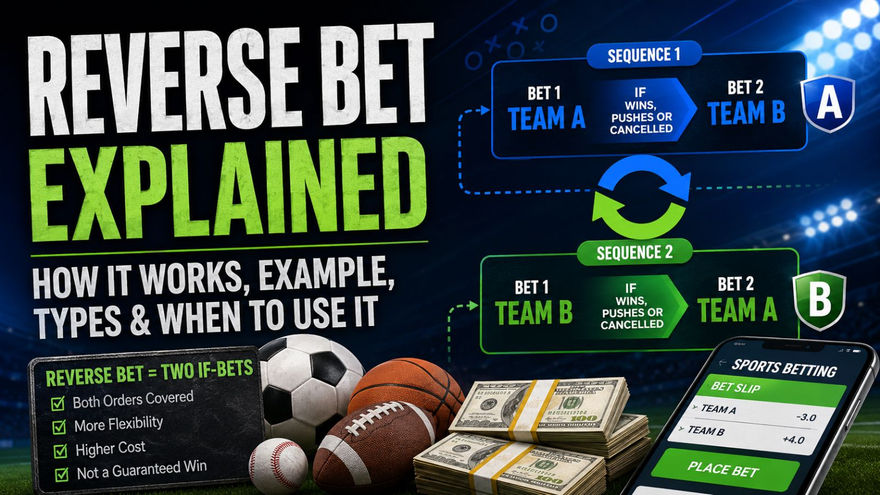
A reverse bet is two if-bets running at the same time in opposite directions.
For a simple two-team reverse bet, you are placing:
Sequence 1: Team A → Team B
Sequence 2: Team B → Team A
So instead of choosing which selection comes first, you cover both orders.
That is the main idea.
A reverse bet does not remove risk. It creates two conditional paths. Because you are placing two if-bets instead of one, your total stake doubles.
For example:
A $50 if-bet costs $50.
A $50 reverse bet costs $100 because it includes two $50 if-bets.
Basic Reverse Bet Structure
Suppose you like two selections:
Team A
Team B
A reverse bet creates two sequences:
Sequence | First Bet | Second Bet Activates If |
Sequence 1 | Team A | Team A wins, pushes, or is cancelled |
Sequence 2 | Team B | Team B wins, pushes, or is cancelled |
If Team A wins, Team B activates in Sequence 1.
If Team B wins, Team A activates in Sequence 2.
If either first selection loses in its sequence, that sequence stops.
This makes reverse bets more flexible than normal if-bets, but also more expensive.
Reverse Bet Example: Two-Team Bet
Let’s use a simple example with two football selections at standard -110 odds.
You choose:
Team A -3
Team B +4
You place a $100 reverse bet, split into two $50 if-bet sequences:
Sequence | First Bet | Conditional Second Bet |
Sequence 1 | $50 on Team A -3 | If Team A wins, $50 on Team B +4 activates |
Sequence 2 | $50 on Team B +4 | If Team B wins, $50 on Team A -3 activates |
At -110 odds, a $50 winning bet returns about $45.45 profit.
Now look at the possible outcomes.
Scenario 1: Both Teams Win
If Team A and Team B both cover:
Sequence 1 wins Team A, then wins Team B.
Sequence 2 wins Team B, then wins Team A.
You effectively win four $50 bets at -110.
Approximate profit:
$45.45 × 4 = $181.80 profit
This is the best-case result.
Scenario 2: Team A Wins, Team B Loses
If Team A wins but Team B loses:
Sequence 1: Team A wins, then Team B activates and loses.
Sequence 2: Team B loses, so Team A never activates.
Approximate result:
Team A win: +$45.45
Team B loss in Sequence 1: -$50
Team B loss in Sequence 2: -$50
Total approximate result: -$54.55
This is why reverse bets can still lose money even when one of your selections wins.
Scenario 3: Team B Wins, Team A Loses
This is the opposite of Scenario 2.
Sequence 1: Team A loses, so Team B never activates.
Sequence 2: Team B wins, then Team A activates and loses.
Approximate result: -$54.55
Again, going 1-for-2 is usually not enough to make the bet profitable.
Scenario 4: Both Teams Lose
If both teams lose:
Sequence 1 stops after Team A loses.
Sequence 2 stops after Team B loses.
You lose both initial $50 wagers.
Total result: -$100
Exact settlement can vary by sportsbook, especially around pushes, cancellations, and whether the stake or winnings roll forward. But the practical lesson is simple: a reverse bet gives you both orders, not a guarantee of profit.
Reverse Bets vs. Parlays and Other Multi-Leg Bets
Reverse bets are often compared with parlays because both involve more than one selection. But they work differently.
A parlay combines selections into one ticket. A reverse bet uses conditional if-bets in both directions.
Feature | Reverse Bet | Parlay | If-Bet | Round Robin |
Structure | Two if-bets in opposite directions | One combined multi-leg bet | One conditional sequence | Multiple parlay combinations |
Order matters? | No, both orders are covered | No | Yes | No |
Cost | Higher than a single if-bet | Usually lower for same selections | Lower than reverse bet | Can become expensive |
Payout style | Straight-bet outcomes inside sequences | Parlay payout | Straight-bet style by sequence | Parlay payouts |
One loss impact | Can still lose money, but not always like a parlay | Usually kills the ticket | Stops that sequence | Depends on combinations |
Best for | Conditional coverage and order flexibility | Higher payout attempt | Ordered confidence | Covering many combinations |
Reverse Bet vs. Parlay
The main difference between a reverse bet and a parlay is how the selections are connected.
In a parlay, all legs usually need to win. One loss normally kills the ticket.
In a reverse bet, the bets are conditional. Each sequence activates only if the first selection wins, pushes, or is cancelled, depending on the sportsbook’s rules.
A parlay usually offers a bigger potential payout for a smaller stake. A reverse bet gives more structure and order flexibility, but it costs more.
If you are still learning the basics of multi-leg wagers, TBP’s guide to types of sports betting can help place reverse bets in context.
Reverse Bet vs. If-Bet
An if-bet has one direction.
Example:
Team A → Team B
A reverse bet has both directions.
Example:
Team A → Team BTeam B → Team A
The advantage of a reverse bet is that you do not need to decide which selection goes first. The downside is that you are paying for both sequences.
Reverse Bet vs. Round Robin
A round robin creates multiple parlay combinations from several selections.
A reverse bet creates multiple conditional if-bet sequences.
With two teams, a reverse bet is fairly simple. With three or more selections, the number of combinations grows quickly. That can make the total stake much higher than beginners expect.
For example, a three-team reverse can create six if-bet combinations. A four-team reverse can create 12. The more selections you add, the more careful you need to be with the total cost.
This is why reverse bets should not be treated casually. They can look small at first, but the stake can multiply quickly.
Types of Reverse Bets: Win vs Action
Some sportsbooks use two related terms: win reverse and action reverse.
They sound similar, but the settlement rules are different.
Type | What It Means |
Win reverse | The next bet activates only if the first bet wins |
Action reverse | The next bet may activate if the first bet wins, pushes, or is cancelled |
An action reverse bet is the more common term in many US-facing sportsbooks. In this format, a push or cancellation does not necessarily stop the sequence. The next bet may still go forward because the first leg did not lose.
A win reverse is stricter. If the first leg does not win, the sequence does not continue.
Always check the sportsbook’s rules before placing this type of wager. Small rule differences can change your final payout, total exposure, and whether the next leg activates.
When to Use and Avoid Reverse Bets
A reverse bet can be useful in specific situations, but it is not necessary for most casual bettors.
It may make sense when:
you understand if-bets clearly
you have two selections you like strongly
you do not want the order of selections to matter
you want more flexibility than a standard if-bet
you are comfortable risking a higher total stake
you have already set a clear betting budget
It may be better to avoid reverse bets when:
you do not fully understand the rules
you are only chasing a bigger payout
the total stake is more than your planned risk
a straight bet or parlay is easier to manage
the sportsbook’s settlement rules are unclear
you are betting emotionally after a loss
The main advantage of a reverse bet is order flexibility. The main drawback is cost.
Because a reverse bet uses multiple if-bet sequences, the stake can become larger than expected. That is why bankroll management matters. You should know your maximum risk before placing the bet.
Reverse bets can also feel safer than parlays, but that can be misleading. You can still lose money even if one selection wins. You usually need both selections to perform well for the bet to be worthwhile.
If you are exploring risk-control ideas, TBP’s guide to hedging may also be useful. Hedging is a different concept, but it also relates to managing exposure after a bet is placed.
How to Place a Reverse Bet
Not every sportsbook offers reverse bets. Some books may list them under conditional wagers, if-bets, or action reverse bets.
The usual process looks like this:
Select two or more betting markets.
Add them to your bet slip.
Look for an “if-bet,” “reverse,” or “action reverse” option.
Choose your stake amount.
Check how many if-bet sequences are being created.
Review the total risk before confirming.
Read the rules for pushes, cancellations, and voided bets.
Do not assume the displayed stake is the full cost until you confirm the number of sequences. A $10 reverse bet may become $20, $60, or more depending on the number of selections and how the sportsbook structures the bet.
If you are new to reverse bets, start with a small two-team example on paper before risking real money. Work through the outcomes first. If you cannot explain how the bet settles, you should not place it yet.
Regional Considerations and Legality
Reverse bets work the same way in principle across countries, but availability and legality vary.
India
Indian users may see reverse bet explanations on international betting sites, but the term is not widely used in local sports betting content.
Sports betting laws in India are complex and vary by state. Online betting may be restricted or unclear depending on where you live. If you are in India, check local laws before placing any sports bet.
A cricket reverse bet example might involve two selections such as:
Team A to win a T20 match
Team B to win another T20 match
The mechanics stay the same. The reverse bet creates both conditional sequences, regardless of whether the sport is cricket, football, basketball, or tennis.
UK
UK bettors may see reverse betting discussed in football or accumulator-style contexts.
For example, a football reverse bet could use:
Arsenal to win
Chelsea to win
The reverse structure would create both orders. But reverse bets are less common than accumulators, singles, and bet builders in the UK market. Always check whether your bookmaker offers this bet type and how it settles pushes or voided selections.
US
Reverse bets and action reverse bets are more common in US-facing sportsbook guides, especially around football, basketball, and point spreads.
US examples often use -110 odds, spreads, and totals. That is why many reverse bet examples show two NFL or college football selections.
Even in the US, rules vary by sportsbook and state. Always check whether reverse bets are allowed and how conditional wagers are settled.
Conclusion
A reverse bet is a conditional sports bet that runs in both directions.
Instead of making one if-bet, you are making two:
Selection A if Selection B
Selection B if Selection A
This removes the need to choose the order, but it also doubles the stake. That trade-off is the whole point of reverse betting.
Reverse bets can help bettors understand conditional wagering, but they are not simple or risk-free. They are best suited to bettors who already understand straight bets, parlays, if-bets, and bankroll control.
If you are still learning, start with easier concepts first. Read TBP’s guides on parlay bets, teaser bets, and the betting terms glossary before using more advanced wager types.
The practical lesson is simple: reverse bets give more flexibility, but they also create more cost and complexity. Use them only when you understand the structure, the risk, and the total amount you are putting at stake.
FAQs
What is a reverse bet in sports betting?
A reverse bet is a wager made up of two if-bets running in opposite directions. For example, it can include Team A if Team B and Team B if Team A on the same ticket.
How does a reverse bet work?
A reverse bet works by creating two conditional betting sequences. If the first selection in a sequence wins, pushes, or is cancelled, the next bet activates, depending on the sportsbook’s rules.
Are reverse bets the same as parlays?
No. A parlay combines selections into one bet where all legs usually need to win. A reverse bet uses conditional if-bets in both directions and usually costs more than a single parlay.
What is the difference between action reverse and win reverse bets?
A win reverse continues only when the first leg wins. An action reverse may continue when the first leg wins, pushes, or is cancelled, depending on sportsbook rules.
How many bets are in a reverse bet?
A two-team reverse bet includes two if-bets. A three-team reverse can create six if-bet combinations, and larger reverse bets create more combinations, which increases the total stake.
When should I use a reverse bet?
A reverse bet may make sense when you like two selections and do not want the order to matter. It is better suited to experienced bettors because it costs more and can be difficult to track.
Do reverse bets reduce risk compared to parlays?
Reverse bets can reduce the all-or-nothing nature of parlays, but they do not remove risk. They also cost more because you are placing multiple conditional sequences.
Are reverse bets worth it?
Reverse bets can be worth considering only if you understand if-bets, total stake, and settlement rules. For many beginners, straight bets or simple parlays are easier to understand and manage.