
Juiced odds are betting odds with extra sportsbook margin built into the price.
In plain terms, a line is “juiced” when you have to risk more than usual to win the same amount, or when the payout is worse than a fair price would suggest.
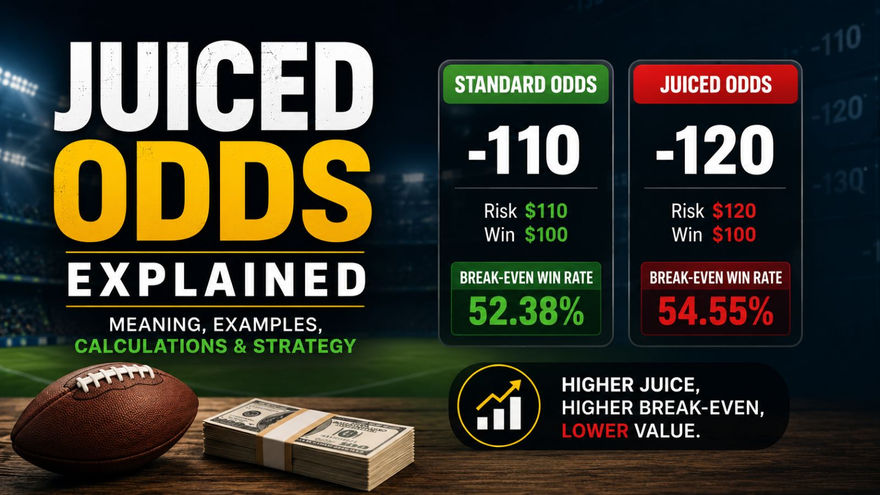
For example, a standard point spread might be priced at -110, meaning you risk $110 to win $100. If the same spread is priced at -120 or -130, it is more heavily juiced. You are still betting the same line, but you are paying a worse price.
That matters because juiced odds raise the win rate you need just to break even. A bet at -110 needs to win about 52.4% of the time to break even. A bet at -120 needs to win about 54.5%.
That difference may look small on one bet. Over many bets, it can decide whether a bettor profits, breaks even, or slowly loses money.
You may also hear juice called vig, vigorish, bookmaker margin, or overround. These terms are closely related. They all describe the sportsbook’s built-in edge.
This guide explains what juiced odds mean, why sportsbooks use them, how to calculate the cost of juice, and how to spot heavily juiced lines before placing a bet.
Why Bookmakers Juice the Odds
Sportsbooks do not usually charge a separate fee when you place a bet. Instead, they build their margin into the odds.
That margin is the juice.
In a fair 50/50 bet, both sides would be priced at +100. You would risk $100 to win $100. But sportsbooks commonly price both sides at -110. That means each bettor risks $110 to win $100.
If one bettor wins and the other loses, the sportsbook pays the winner and keeps a margin from the losing stake. The bookmaker does not need to predict the winner of every event. It earns from the pricing.
Sportsbooks juice odds for several reasons:
To earn a margin on betting markets
To manage risk when too much money comes in on one side
To balance action between two outcomes
To adjust prices without changing the spread, total, or main betting line
To protect themselves in lower-volume or harder-to-price markets
For example, suppose an NFL spread opens like this:
Team | Spread | Odds |
Team A | -3 | -110 |
Team B | +3 | -110 |
If most bettors back Team A, the sportsbook may not want to move the spread from -3 to -3.5. Instead, it may increase the juice on Team A:
Team | Spread | Odds |
Team A | -3 | -120 |
Team B | +3 | +100 |
The spread is still -3, but Team A is now more expensive to bet. That is a juiced line.
The bettor still gets the same spread. The difference is the price.
Standard vs Reduced vs Heavily Juiced Odds
Not all odds carry the same amount of juice.
Some lines have standard juice. Some have reduced juice. Others are heavily juiced.
The easiest way to understand the difference is to look at how much you must risk to win $100.
Odds Type | American Odds | Decimal Odds Approx. | Risk to Win $100 | Break-Even Win Rate |
No juice / fair odds | +100 | 2.00 | $100 | 50.00% |
Reduced juice | -105 | 1.95 | $105 | 51.22% |
Standard juice | -110 | 1.91 | $110 | 52.38% |
Higher juice | -120 | 1.83 | $120 | 54.55% |
Heavily juiced | -130 | 1.77 | $130 | 56.52% |
A standard spread or total is often priced around -110. That is common in US betting markets.
Reduced juice means the sportsbook is charging less than usual, such as -105 instead of -110. That helps the bettor because the break-even point is lower.
Heavily juiced odds mean the sportsbook is charging more than usual. At -130, you need to win 56.52% of your bets just to break even. That is a much higher bar.
Why the Difference Matters
Imagine two bettors both win 55 out of 100 bets.
Bettor A takes -110 odds each time. Bettor B takes -120 odds each time.
Bettor | Odds | Wins | Losses | Result |
Bettor A | -110 | 55 | 45 | Profitable |
Bettor B | -120 | 55 | 45 | Barely profitable |
At -110, a 55% win rate gives you some room above break-even. At -120, most of that edge disappears.
This is why experienced bettors care so much about price. Picking winners is not enough if you keep accepting bad odds.
Calculating Juice & Break-Even Percentages
You do not need advanced math to understand juice. The basic idea is simple: the more negative the odds, the higher your required win rate.
For negative American odds, the break-even formula is:
Break-even percentage = Odds ÷ (Odds + 100)
Use the absolute value of the odds. So for -110, use 110.
Example 1: Standard -110 Juice
At -110:
110 ÷ (110 + 100) = 110 ÷ 210 = 52.38%
That means a bettor must win 52.38% of -110 bets to break even.
If you win 50% of your bets at -110, you lose money over time.
Example 2: Heavily Juiced -120 Line
At -120:
120 ÷ (120 + 100) = 120 ÷ 220 = 54.55%
That means a bettor must win 54.55% of -120 bets just to break even.
The bet itself may not have changed. The team, spread, or total may be the same. But the price is worse.
Example 3: Calculating Juice in a Two-Way Market
You can also calculate the bookmaker’s margin by converting both sides of a market into implied probability.
Suppose both sides of a point spread are priced at -110:
Side | Odds | Implied Probability |
Team A | -110 | 52.38% |
Team B | -110 | 52.38% |
Total | — | 104.76% |
A fair two-way market would total 100%. Here, it totals 104.76%.
That extra 4.76% is the sportsbook’s margin. This is also called the overround in many UK and international markets.
For a deeper explanation of the underlying term, read our guide to vig or juice.
Examples of Juiced Odds in Different Bet Types
Juiced odds can appear in several betting markets.
They are easiest to notice in point spreads and totals, but they can also appear in moneylines, player props, parlays, futures, and live betting.
Example 1: Point Spread Bet
Suppose a basketball game is priced like this:
Bet | Odds | Meaning |
Team A -4.5 | -110 | Risk $110 to win $100 |
Team B +4.5 | -110 | Risk $110 to win $100 |
That is standard juice.
Now suppose heavy betting comes in on Team A. The sportsbook may adjust the odds:
Bet | Odds | Meaning |
Team A -4.5 | -125 | Risk $125 to win $100 |
Team B +4.5 | +105 | Risk $100 to win $105 |
Team A is now heavily juiced. You still get the same -4.5 spread, but you must pay a worse price.
A beginner might think, “The spread did not move, so nothing changed.” But something did change. The cost of betting Team A increased.
Example 2: Moneyline Odds
Juice on moneylines is harder to spot because the two sides are not usually priced the same.
Suppose a tennis match has a fair underdog price of +150. That means a $100 bet would win $150 in profit.
But the sportsbook offers only +140.
Price Type | Odds | Profit on $100 Bet |
Fairer price | +150 | $150 |
Juiced price | +140 | $140 |
Difference | — | $10 less profit |
One bet may not seem important. But if you win 20 similar bets, the difference becomes:
20 wins × $10 = $200 less profit
That is how juiced odds reduce long-term returns.
Example 3: Totals and Player Props
A totals market might look like this:
Bet | Odds |
Over 220.5 points | -115 |
Under 220.5 points | -115 |
Both sides are priced worse than the usual -110. That means the market is more expensive for bettors.
Player props can be even more heavily juiced because they often have lower limits, less liquidity, and more uncertainty.
For example:
Player Prop | Odds |
Player over 24.5 points | -125 |
Player under 24.5 points | -105 |
The over is heavily juiced. A bettor backing the over must be confident that the true probability is high enough to justify that price.
Example 4: Live Betting
Live betting markets can become heavily juiced because odds change quickly during the game.
Suppose a cricket team was fairly priced at +150 during a chase, but the live market offers only +140. The sportsbook may have shortened the odds to protect itself against fast-changing information, user demand, or market volatility.
The bettor may still like the bet. But the price is now worse.
Live betting can be useful, but it requires extra caution because the juice can be higher and harder to notice in real time.
How to Spot & Avoid Heavily Juiced Odds
You cannot avoid juice completely. It is part of sportsbook pricing.
But you can avoid paying more juice than necessary.
1. Compare the Same Bet Across Markets
Before placing a bet, compare the same line across different sportsbooks or exchanges where legal and available.
For example:
Bookmaker | Bet | Odds |
Book A | Team A -3 | -120 |
Book B | Team A -3 | -110 |
Book C | Team A -3 | -105 |
The bet is the same, but the price is different.
Book C gives the best price. You risk $105 to win $100 instead of risking $120 to win $100.
That difference matters over time.
2. Be Careful With -120, -130, or Worse
A heavily juiced line is not automatically a bad bet. Sometimes the true probability still supports the price.
But beginners should be cautious with odds such as:
-120
-125
-130
-150 or shorter on props or side markets
These prices require a higher win rate. The bet may feel safer because the outcome looks likely, but the payout may not justify the risk.
3. Watch Player Props and Live Bets
Player props, game props, futures, and live betting markets often carry more juice than standard spreads or totals.
That does not mean you should never bet them. It means you should check the price carefully.
A prop at -135 may need a much stronger probability edge than a standard spread at -110.
4. Do Not Chase “Safe” Short Odds
Many beginners see short odds and think the bet is safer.
That can be misleading.
A bet at -250 may win more often than it loses, but it still needs to win at a very high rate to be profitable. If the odds are over-juiced, the risk may not be worth the payout.
The question should not be only, “Will this bet win?”
The better question is:
Is this price good enough for the risk?
That is where understanding value bets becomes useful.
Juiced Odds vs Juice / Vigorish vs Overround
These terms are closely related, but they are not exactly the same.
Term | Meaning |
Juice | The sportsbook’s built-in margin or fee |
Vig / Vigorish | Another name for juice |
Juiced odds | Odds that include higher-than-normal juice |
Juiced line | A betting line with a worse price because of extra vig |
Overround | The total bookmaker margin across all outcomes in a market |
Think of it this way:
Juice is the cost.
Juiced odds are the odds that show that cost.
Overround is the total margin when you add up implied probabilities across a full market.
In the US, bettors often say “juice” or “vig.” In the UK and other international markets, “overround” or “bookmaker margin” may be more common.
The concept is the same: the sportsbook has built a margin into the odds.
Juiced Odds & Bankroll Discipline
Understanding juiced odds is not just about definitions. It affects how you manage your money.
A heavily juiced bet can look attractive because it may involve a strong favorite or a popular market. But the higher the juice, the more often you need to win.
That makes bankroll management important.
A simple beginner approach:
Do not increase your stake just because a bet looks likely to win.
Avoid risking large amounts on heavily juiced favorites.
Compare prices before betting.
Track the odds you accept, not just whether the bet wins or loses.
Be cautious with live bets and player props.
Do not chase losses with short-priced bets.
Learn how break-even percentage connects to expected value.
Your betting stake is the amount you risk on a wager. When odds are juiced, that risk becomes more expensive relative to the possible return.
A good betting decision is not only about picking the right side. It is also about taking the right price.
Conclusion
Juiced odds mean the sportsbook has built extra margin into the betting line.
A standard spread at -110 already includes juice. A line at -120, -125, or -130 is more heavily juiced because you must risk more to win the same amount. In decimal odds, this means the payout is shorter than a fairer price would be.
The practical lesson is simple: do not look only at the team, player, or outcome. Look at the price.
Juiced odds raise your break-even point and reduce long-term returns. By comparing lines, avoiding unnecessary high vig, and understanding how juice affects your bankroll, you can make clearer and more disciplined betting decisions.
FAQs
What are juiced odds?
Juiced odds are betting odds where the sportsbook has added extra margin, making the price less favorable for the bettor. For example, a line priced at -120 instead of -110 is more heavily juiced because you must risk more to win the same amount.
Why do bookmakers juice the odds?
Bookmakers juice the odds to build in profit and manage risk. Instead of charging a separate fee, sportsbooks adjust the odds so the market includes their margin.
How do I calculate juice on betting odds?
You calculate juice by converting each side of a market into implied probability and adding the percentages together. Anything above 100% is the bookmaker’s margin, also called the juice, vig, or overround.
Are juiced odds good or bad?
Juiced odds are usually less favorable for bettors because they raise the break-even win rate. A heavily juiced bet can still be profitable if the true probability is strong enough, but beginners should be careful about paying too much vig.
What’s the difference between juiced lines and reduced juice?
Juiced lines have higher vig, such as -120 or -130. Reduced juice means the sportsbook charges less vig, such as -105 instead of -110, allowing bettors to risk less to win the same amount.
Is overround the same as juiced odds?
Overround is the bookmaker’s total margin across a betting market. Juiced odds are individual prices that include that margin. The terms are closely related, but overround usually refers to the whole market rather than one line.
Can I beat juiced odds?
You can beat juiced odds only if your edge is strong enough to overcome the higher break-even point. For most beginners, the better approach is to compare prices, avoid unnecessary high vig, and focus on finding value rather than chasing short odds.