
A steam move in sports betting is a sudden, sharp line movement that happens across multiple sportsbooks at nearly the same time.
It usually means the market has reacted quickly to something significant: sharp money, a betting syndicate, breaking team news, injury information, or a sudden correction to a weak opening line.
The key point for beginners is simple: a steam move is not one sportsbook changing a price. It is a market-wide move.
That matters because steam can point toward useful information, but it can also trap bettors who react too late. If the best number is already gone, chasing the move may mean taking a worse price than the bettors who caused the move in the first place.
Here is the quick version:
Term | Simple Meaning | Why It Matters |
Betting line | The sportsbook’s price, spread, or total | Steam moves happen when this number changes quickly |
Sharp money | Money from respected or professional bettors | Often one reason steam moves happen |
Steam move | Fast, market-wide line movement across several sportsbooks | Can signal sharp action or major new information |
Chasing steam | Betting after a steam move starts, hoping to catch the old price | Can work only if you are fast and the move is real |
Fake steam | A misleading move that may reverse later | Dangerous for bettors who follow every move blindly |
This guide explains what steam moves are, how they happen, how to spot real steam, when chasing steam becomes risky, and how bettors should react without overbetting.
What Are Steam Moves? Definition & History
A steam move is a rapid, significant betting line movement that appears across multiple sportsbooks within a short period.
A normal line move can happen at one sportsbook because that book has taken more money on one side, adjusted its own risk, or copied another operator. Steam is different. Steam means the wider market is moving together.
In simple terms:
A steam move is a fast, market-wide odds or line movement usually caused by sharp money, syndicate betting, breaking news, or a quick correction to a soft price.
Steam can affect many betting markets, including:
point spreads
moneylines
totals
player props
cricket match-winner odds
football/soccer handicaps
tennis match odds
The term comes from the idea of pressure building quickly. When serious money or important information hits the market, the line starts “steaming” in one direction.
Steam Move vs Ordinary Line Move
Type of Move | What Happens | What It Usually Means |
Ordinary line move | One sportsbook changes its price | Local risk adjustment, small market reaction, or routine pricing update |
Public move | The line moves gradually because many casual bettors back one side | Public demand may be influencing the price |
Steam move | Several sportsbooks move quickly in the same direction | Stronger market signal, often from sharp action or major information |
Fake steam | A move looks sharp but later reverses or was created to influence the market | Bettors may be chasing the wrong side |
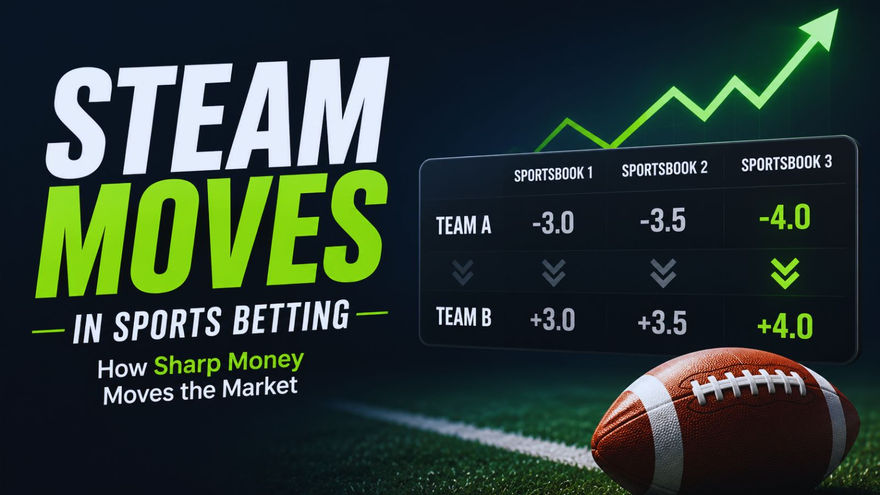
A single sportsbook moving from Team A -3 to Team A -3.5 is not automatically steam.
But if several sportsbooks move from -3 to -4 within minutes, that is much closer to a true steam move.
This is why understanding a betting line matters before trying to understand steam. Steam is not only about which team is being backed. It is about how quickly and widely the market price changes.
How Steam Moves Happen: Mechanics
Steam moves usually happen when the betting market reacts quickly to serious money or important new information.
The basic sequence looks like this:
A sharp bettor, syndicate, or well-informed group identifies value.
They place large bets, often at respected market-making sportsbooks.
Those sportsbooks move the line to manage risk and reflect the new market position.
Other sportsbooks see the move and adjust their own numbers.
Bettors watching the market notice the same price moving across several books.
For example:
Stage | Line |
Opening spread | Team A -3 |
Sharp action hits Team A | Team A -3.5 |
Other sportsbooks adjust | Team A -4 |
Slower books catch up | Team A -4 or -4.5 |
A bettor who got Team A -3 before the move has a better number than someone who bets Team A -4.5 after the move.
That difference matters because many sports bets are decided by small margins.
Causes of Steam: Sharp Action vs Injury News
Steam moves do not all happen for the same reason.
The most common causes include:
Sharp money: Respected bettors or syndicates place large wagers on one side.
Breaking injury news: A key player is ruled out or unexpectedly confirmed fit.
Roster or lineup changes: A team rests important players, changes its starting XI, or announces a surprise selection.
Weather updates: Wind, rain, heat, or pitch conditions affect totals or match outcome prices.
Limit increases: Sportsbooks raise betting limits closer to the event, allowing bigger bettors to enter the market.
Copied market movement: Smaller sportsbooks follow the numbers posted by sharper sportsbooks.
Market correction: An opening line was too soft and gets corrected quickly.
Not every sudden move is sharp money. Sometimes the market is simply reacting to public news.
For example, if a star quarterback is ruled out and every sportsbook moves the spread within minutes, that is a steam move caused by information. If a betting syndicate hits the same side across several books before the news becomes widely known, that is closer to sharp steam.
The bettor’s job is not only to see the move. The bettor’s job is to ask why the move happened.
Fake Steam & Head Fakes
A fake steam move, also called a head fake, happens when a line move looks meaningful but may not represent the side sharp bettors truly want.
Example:
A syndicate likes Team B at +5.5.
Before betting Team B heavily, it places a smaller but noticeable bet on Team A.
The market reacts and moves Team B from +5.5 to +6.5.
The syndicate then bets more heavily on Team B at the better number.
The first move helped create the price they actually wanted.
This is why blindly chasing steam can be dangerous. You may think you are following sharp money, but you could be following a move designed to improve the number on the other side.
Fake steam is difficult for beginners to identify. The safer approach is to treat every steam move as a signal, not an automatic bet.
Examples of Steam Moves
Examples make steam moves easier to understand. The exact teams are less important than the betting sequence.
NFL Example: Point Spread Steam
Suppose an NFL game opens like this:
Stage | Line |
Opening line | Team A -3 |
Sharp money hits Team A | Team A -3.5 |
Several sportsbooks move quickly | Team A -4 |
Final pre-game line | Team A -4.5 |
This is a classic steam move if the shift happens quickly across multiple books.
A bettor who took Team A -3 has a much stronger number than a bettor who joined late at -4.5. If Team A wins by 4, the early bettor wins while the late bettor loses.
That is why steam moves are linked to closing line value. Beating the final market number can be useful over time, but it does not guarantee that any single bet will win.
Soccer Example: Late Team News
Imagine a Champions League match where Club A opens at 2.10 to win.
Two hours before kickoff, reports suggest Club B’s first-choice goalkeeper and main center-back are both out. Several respected sportsbooks react quickly.
Stage | Club A Odds |
Opening odds | 2.10 |
After team news | 1.95 |
Wider market catches up | 1.85 |
If this move happens across many sportsbooks within a short period, it may be considered steam.
But a bettor who waits too long may no longer have value. Club A at 2.10 and Club A at 1.85 are not the same bet.
Cricket Example: Pitch and Toss Information
Steam can also happen in cricket, especially around the toss, pitch report, or final XI.
Suppose a T20 match opens with Team A at 1.95.
Then the pitch report suggests heavy spin assistance, and Team A names three quality spinners. Several books shorten Team A quickly.
Stage | Team A Odds |
Early market | 1.95 |
After pitch and XI news | 1.82 |
Market-wide move | 1.75 |
This can be a steam move if multiple sportsbooks adjust together.
The reason matters. If the move is based on real team and pitch information, it may be logical. If it is only public excitement after the toss, the signal may be weaker.
Why Steam Moves Matter for Bettors
Steam moves matter because they show how quickly betting markets can react.
For beginners, there are three practical lessons.
First, odds are not fixed. Sportsbooks constantly adjust prices based on money, information, risk, and wider market movement.
Second, timing matters. A bet that looked good at one number may become poor at another number.
Third, steam is not a guarantee. A steam move may indicate sharp opinion or useful information, but it does not mean the moved side will win.
Steam moves are closely connected to value betting. The question is not simply, “Which way did the line move?” The better question is, “Is there still value at the current price?”
For example:
Team A -3 may be a good bet.
Team A -4 may be acceptable.
Team A -5.5 may be too expensive.
All three bets are on the same side, but they are not the same price.
That is why disciplined bettors care about the number. They do not chase every move just because it looks sharp.
Steam moves also matter for bankroll management. A sudden line move creates urgency, and urgency often leads to poor staking decisions. Bettors may increase their stake because they fear missing out. That is usually a mistake.
Chasing Steam: Pros & Cons
Chasing steam means trying to bet the old number at a slower sportsbook after sharper books have already moved.
Example:
A sharp book moves from Team A -3 to -4.
A slower book still has Team A -3.
A bettor quickly takes Team A -3 before the slower book updates.
That can be valuable if the move is real and the bettor gets the old number in time.
But chasing steam is not beginner-friendly. It requires speed, multiple sportsbook accounts, strong market awareness, and the ability to separate real steam from noise.
Pros and Cons of Chasing Steam
Pros | Cons |
Can help bettors capture better numbers before the market fully adjusts | Very difficult to do quickly enough |
Can improve closing line value when the move is genuine | Some moves are fake or misleading |
Helps bettors understand sharp market behavior | Late bettors often get the worst number |
Can reveal where respected money is entering the market | Sportsbooks may limit accounts that consistently beat stale numbers |
Useful for learning market timing | Can encourage rushed, emotional betting |
The biggest mistake is chasing steam after the value has already gone.
If a line moves from -3 to -5 and you bet -5 only because the market moved, you may be entering too late. The sharp bettor may have taken -3. You are taking a worse number.
That is not the same bet.
How to Identify Real Steam Moves
You cannot identify real steam perfectly, but you can look for stronger signals.
Use this checklist before reacting.
1. Is the Move Happening Across Multiple Sportsbooks?
Real steam usually moves the market, not just one sportsbook.
If only one book changes its price, it may be a local adjustment. If several books move in the same direction within minutes, the signal is stronger.
2. How Fast Did the Line Move?
Speed matters.
A slow drift over several hours may be ordinary public money or routine adjustment. A sharp move across books within minutes is more likely to be steam.
3. Which Sportsbook Moved First?
Not all sportsbooks carry the same market influence.
Some books are known for taking larger bets and reacting faster to sharp action. If a respected market-making book moves first and others follow, the move carries more weight.
A move that starts at a softer book may be less meaningful.
4. Is There a Clear Reason?
Ask why the move happened.
Possible reasons include:
injury news
team news
weather update
pitch report
limit increase
respected sharp action
sudden information leak
If you cannot identify any reason, be careful. The move may still be sharp, but it may also be noise.
5. Did the Move Reverse Quickly?
If the line moves sharply and then quickly returns, that may suggest a head fake or overreaction.
Example:
Time | Line |
10:00 AM | Team A -3 |
10:10 AM | Team A -4 |
10:40 AM | Team A -3.5 |
11:15 AM | Team A -3 |
That kind of reversal deserves caution.
6. Is the New Number Still Worth Betting?
This is the most important question.
A steam move can be real, but the current price can still be bad.
Do not ask only:
Did sharp money move this line?
Ask:
Is this still a value bet at the number I can get now?
That difference separates useful market reading from blind chasing.
Best Practices for Reacting to Steam
Steam moves create pressure. Bettors feel they need to act immediately.
That pressure is exactly why discipline matters.
1. Understand the Move Before Betting
Do not bet just because the market moved.
Check the likely trigger:
Was there news?
Did a major sportsbook move first?
Is the move market-wide?
Has the line already gone too far?
Is the move against public opinion or with it?
A fast decision can still be a poor decision.
2. Compare the Current Number With the Old Number
Steam often changes the value of a bet.
If the original line was Team A -3 and the current line is Team A -5, the market has already moved two points. The bettor who created the steam may have value. You may not.
3. Keep Stakes Consistent
Do not increase your stake just because a steam move looks exciting.
A beginner-friendly rule is simple: treat steam as information, not permission to overbet.
4. Accept That You Will Miss Some Moves
Most bettors will not catch every good number.
That is normal.
Chasing every line move creates rushed decisions and can damage your bankroll. Passing after the price is gone is often smarter than forcing a late bet.
5. Track Your Results
If you react to steam moves, record:
opening line
line you bet
closing line
reason for the move
result
whether you beat the closing number
Over time, this helps you see whether you are actually finding value or simply following movement.
6. Start Small
Steam moves can feel advanced because they involve market timing.
Beginners should start with small stakes, learn how lines move, and avoid treating steam as a shortcut to profit.
Common Myths & Misconceptions
Steam moves are useful to understand, but many bettors misunderstand them.
Myth 1: Steam Always Means the Bet Will Win
Steam does not guarantee anything.
It may show respected money or important information, but the result can still go the other way. Sports outcomes remain uncertain.
Myth 2: Every Steam Move Comes From Sharp Bettors
Some steam moves are caused by injury news, lineup changes, public reaction, market copying, or limit adjustments.
Sharp money is common, but it is not the only cause.
Myth 3: Chasing Steam Is Easy Money
Chasing steam is difficult because the best number disappears quickly.
By the time many casual bettors notice the move, the market may already be efficient. Betting late can mean taking the worst price.
Myth 4: A Single-Book Move Is Always Steam
A move at one sportsbook may be local risk management.
Steam usually means several sportsbooks move quickly in the same direction.
Myth 5: Steam Only Happens in US Sports
Steam is more commonly discussed in US sports betting, especially NFL and basketball, but the concept can apply anywhere there are multiple sportsbooks and liquid betting markets.
That includes soccer, cricket, tennis, and other global markets.
Geo & Legal Considerations
Steam moves rely on active betting markets and multiple sportsbooks adjusting prices quickly.
In the US and UK, where many regulated sportsbooks operate, steam moves can be easier to observe. In global football/soccer markets, they may appear in match-winner odds, Asian handicaps, totals, or team news reactions.
For Indian bettors, the term may be less common, and local betting rules can be complex. Some users may only encounter steam moves through offshore books, odds comparison screens, or international betting content.
Always check the laws where you live before placing any bet. Betting market concepts are educational; they do not remove financial risk.
Conclusion & Key Takeaways
A steam move is a sudden, market-wide betting line movement across multiple sportsbooks.
It often happens when sharp bettors, syndicates, breaking news, or limit changes force the market to adjust quickly. Steam can reveal important information, but it is not a guaranteed winning signal.
The most important takeaway is this:
Steam moves are signals, not automatic bets.
Key points to remember:
A steam move is not the same as a normal line move.
True steam usually happens across multiple sportsbooks.
Sharp money can trigger steam, but so can news or limit changes.
Chasing steam means trying to bet the old number before it disappears.
Fake steam and head fakes can mislead bettors.
The current price matters more than the direction of the move.
Bankroll discipline is essential.
Sometimes the best decision is to let the move pass.
For deeper learning, read TBP’s guides on betting lines, point spreads, closing line value, value betting, and bankroll management.
FAQs
What is a steam move in sports betting?
A steam move is a sudden, sharp line movement that happens across multiple sportsbooks at nearly the same time. It is usually caused by sharp money, syndicate betting, breaking news, or a major market correction.
Why do steam moves happen?
Steam moves happen when sportsbooks react quickly to heavy money or important new information. This can include sharp bettors placing large wagers, injury news, lineup changes, weather updates, or betting limits increasing closer to the event.
How can I tell if a line move is real steam or noise?
Real steam usually moves quickly across several sportsbooks in the same direction. A move is more credible if it starts at a respected market-making book, has a clear trigger, and does not immediately reverse.
Should I chase steam moves?
Chasing steam moves can work only if you catch the old number before the market adjusts. It is risky because many bettors react too late, take a worse price, or follow fake steam without understanding why the line moved.
What is a fake steam move or head fake?
A fake steam move, or head fake, is a misleading move that may be created to push the market in one direction before bigger money comes in on the other side. This is one reason blindly following every steam move can be dangerous.
Are steam moves only in US sports?
No. Steam moves can happen in any sport with active betting markets and multiple sportsbooks. They are often discussed in US sports like NFL and basketball, but they can also happen in soccer, cricket, tennis, and other global markets.
Will sportsbooks limit my account for chasing steam?
Some sportsbooks may limit accounts that consistently beat stale numbers or win by exploiting slow-moving lines. This is another reason chasing steam is more difficult in practice than it sounds in theory.