
In the world of sports betting, success is often measured not just by wins and losses, but by the ability to consistently beat the market. One of the most reliable indicators of long-term profitability is Closing Line Value (CLV) — a concept every serious bettor should understand. This article breaks down what CLV is, why it matters, and how you can use it to sharpen your betting strategy.
What is Closing Line Value (CLV) in Betting?
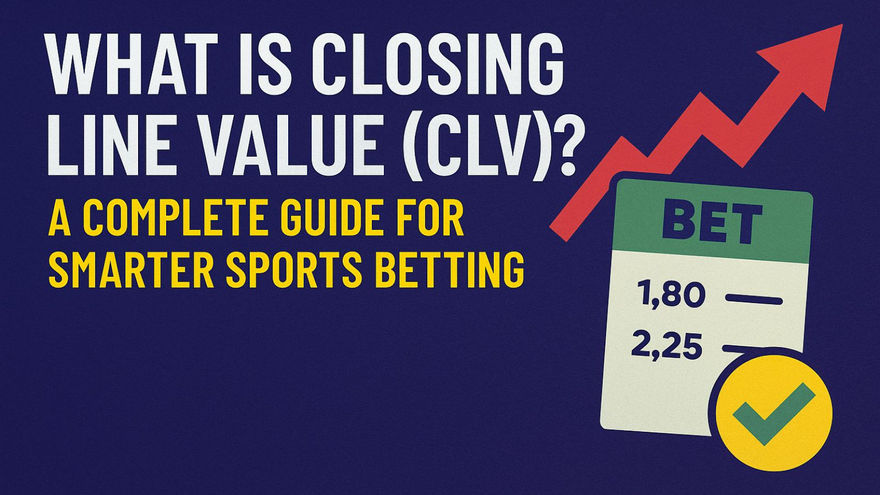
Closing Line Value refers to the difference between the odds at which you placed your bet and the final odds (closing line) offered just before the event starts. It helps determine whether you beat the market, meaning you got better value than what was ultimately available.
Closing Line Value Formula:
CLV = Your Bet Odds – Closing Odds
Positive CLV: You bet at better odds than the closing line.
Negative CLV: You bet at worse odds than the closing line.
Why is CLV Important?
1. Long-Term Profitability
CLV is not about whether you win a single bet. It’s about assessing whether you're consistently finding value. Bettors who regularly beat the closing line are likely to be profitable over the long run, even if short-term variance results in losses.
2. Market Efficiency
Markets like sportsbooks sharpen their odds over time with public money and sharp action. The closing line is considered the most accurate reflection of a team’s chances. Beating it often means your analysis was sharper than the market’s.
3. Performance Evaluation
CLV provides a metric to evaluate your performance independently of luck or short-term results. Even if your bets lose, positive CLV shows you’re making smart bets that will pay off over time.
Examples of CLV in Action
Example 1:
Your Bet:
Team A at +150 (American) → 2.50 (Decimal) on Wednesday
Closing Line:
+130 (American) → 2.30 (Decimal) on game day
CLV Calculation (American Odds):
CLV = +150 − +130 = +20 (positive CLV)
CLV Comparison (Decimal Odds):
CLV = 2.50 − 2.30 = +0.20 (positive CLV)
Result:You beat the market and locked in better odds than the closing price.
Example 2:
Your Bet:
Team B at -110 (American) → 1.91 (Decimal)
Closing Line:
-120 (American) → 1.83 (Decimal)
CLV Calculation (American Odds):CLV = -110 − (-120) = +10 (positive CLV)
CLV Comparison (Decimal Odds):CLV = 1.91 − 1.83 = +0.08 (positive CLV)
Result:Even though both lines are negative, your original wager still secures more favorable terms than the closing line.
How to Achieve Positive CLV
Bet Early
Markets are less efficient early, and sportsbooks may offer softer lines. Betting early increases your chances of getting value.
✅ Shop for the Best Odds
Use multiple sportsbooks and always bet at the best available line.
✅ Follow Line Movements
Understand how and why odds move — injury reports, weather changes, or public sentiment can all shift lines.
✅ Specialize in a Niche
Focusing on specific leagues or markets (e.g., college basketball, tennis) can give you an edge over the general betting public.
CLV is Not a Guarantee of a Win
A common misunderstanding is assuming positive CLV guarantees wins. It doesn't. For instance, you might bet on a team at +200 that closes at +150 — excellent CLV — but the team still loses. That doesn’t mean the bet was poor; over many such bets, you’ll likely profit.
How to Track Your CLV
To effectively use CLV:
Record every bet’s odds and time
Note the closing odds
Calculate the difference
Use tools like BetStamp, Trademate Sports, or manual spreadsheets
Some bettors also use Expected Value (EV) models alongside CLV to fine-tune their selections.
Closing Line Value (CLV) is one of the clearest indicators of betting sharpness. It helps you focus on long-term value instead of short-term results. While it doesn’t predict outcomes, it tells you whether you're consistently getting the best of the number — and that’s how professional bettors stay ahead of the game.
FAQs About CLV
Is CLV more important than win/loss?
Yes. Win/loss is short-term. CLV reflects consistent smart decision-making.
Can recreational bettors benefit from CLV?
Absolutely. Even casual bettors can improve results by aiming for positive CLV.
Is CLV useful in live betting?
Less so. Live odds fluctuate rapidly, making CLV harder to track reliably.