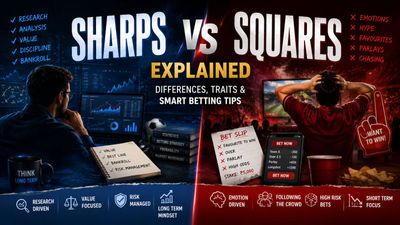


Public money and sharp money describe two different types of betting action.
Public money usually comes from casual bettors. These are recreational bettors who often back popular teams, favourites, overs, star players and outcomes that feel easy to support.
Sharp money usually comes from professional, highly skilled or data-driven bettors. These bettors focus less on which team they like and more on whether the odds are priced incorrectly.
The difference matters because sportsbooks do not treat every bet the same way. A large number of small public bets may not move a line as much as a smaller number of respected sharp bets. That is why bettors pay attention to betting splits, line movement, reverse line movement and sharp money signals.
This guide explains what public money and sharp money mean, how they differ, how betting splits work, and why beginners should not blindly follow sharps or automatically fade the public.
The goal is not to give you a shortcut to guaranteed profit. It is to help you read betting markets more clearly.
What Is Public Money?
Public money is betting money that comes from casual or recreational bettors.
These bettors usually make up a large share of the betting market. They may bet for entertainment, support a favourite team, follow a media narrative or react to recent results.
Public bettors are not always wrong. They can win individual bets. But as a group, public money often follows predictable patterns.
Public money often goes toward:
Popular teams
Favourites
Overs
Star players
Big-name clubs or franchises
National teams with large fan bases
Teams coming off a big win
Media-hyped outcomes
Parlays with exciting payouts
For example, in an NFL game, many casual bettors may back a famous team because they recognise the brand. In football, public bettors may prefer a major Premier League club over a smaller opponent. In cricket, casual bettors may heavily back a popular national team or an IPL side with star players.
That does not make those bets automatically bad. The issue is price.
If too many bettors pile onto the same side, the sportsbook may adjust the line or odds. That can make the popular side more expensive and reduce its value.
Public money is often:
Emotional
Narrative-driven
Late to the market
Less price-sensitive
Heavily concentrated on obvious sides
More likely to chase favourites and overs
A beginner should understand what a stake is before thinking too deeply about public money or sharp money. Bet size is one of the key differences between casual betting action and sharper market action.
What Is Sharp Money?
Sharp money is betting money that comes from professional bettors, betting syndicates or highly disciplined bettors who focus on long-term value.
A sharp bettor is not simply someone who wins one big bet. A sharp is someone who consistently looks for mispriced odds and makes disciplined decisions across a large sample of bets.
Sharp bettors usually care more about price than opinion.
They are not asking only:
“Who will win?”
They are asking:
“Are the odds better than the true chance of this outcome?”
For example, a sharp bettor may not love an underdog’s chances of winning outright. But if the sportsbook has priced that underdog too generously, the sharp may still bet it because the number offers value.
Sharp money often has these traits:
Data-driven analysis
Strong price awareness
Larger or more selective bets
Early betting before the public reacts
Fast action after injuries, team news or market errors
Focus on value rather than fan loyalty
Interest in beating the closing line
The idea of closing line value is important here. If a sharp bettor takes Team A +4.5 and the line closes at Team A +3, they have beaten the closing line. That does not guarantee the bet will win, but it suggests they got a better price than the final market.
Sharp bettors can still lose. They often lose individual bets. Their edge comes from making better-priced decisions repeatedly, not from knowing every result in advance.
Sharp Money vs Public Money: Comparison Table
The easiest way to understand public money vs sharp money is to compare how each group usually behaves.
Factor | Public Money | Sharp Money |
Who is betting? | Casual or recreational bettors | Professional, semi-professional or highly disciplined bettors |
Main motivation | Entertainment, favourites, narratives, team loyalty | Value, price, probability, market inefficiency |
Typical bet size | Often smaller and more frequent | Often larger, selective or strategically timed |
Timing | Often closer to game time | Often early or quickly after news breaks |
Common picks | Favourites, overs, popular teams, star players | Mispriced sides, unpopular numbers, value positions |
Price sensitivity | Lower; may accept worse odds | Higher; small price changes matter |
Line influence | Can move lines through volume | Can move lines because sportsbooks respect the bettor |
Sportsbook reaction | Often viewed as predictable public action | Often treated as important market information |
Betting style | Emotional or narrative-led | Data-driven and disciplined |
This comparison does not mean every recreational bettor is careless or every sharp bettor is right. It describes common market behaviour.
A casual bettor may make a smart bet. A sharp bettor may make a losing bet. The difference is usually process, price discipline and long-term decision quality.
This is also why understanding a betting line matters. Public and sharp money often show up through line movement, not just through the side bettors choose.
How Public & Sharp Money Affect Line Movement
Betting lines move when sportsbooks adjust the odds, spread, total or moneyline based on market information.
A sportsbook may move a line because of:
Injury news
Team selection news
Weather
Market-wide odds movement
Heavy public betting
Sharp action
Risk management
New information from respected bettors
The important point is this:
Sportsbooks do not only care how much money comes in. They also care who is betting.
A large public bet may matter less than a smaller bet from a respected sharp account. Sportsbooks track bettor behaviour. If certain accounts have a history of beating the market, their action may carry more weight.
Public Money and Line Movement
Public money can push a line toward popular sides.
Example:
Stage | Market |
Opening line | Team A -3 |
Public action | Heavy bets on Team A |
Possible adjustment | Team A -3.5 or Team A -4 |
This often happens with favourites, famous teams, overs and highly televised games.
A sportsbook may move the line because too many bettors are on one side. It may also shade the line in advance if it expects public money to arrive.
For example, in a cricket match involving a popular national team, the sportsbook may expect casual bettors to back the famous side. The opening price may already reflect some of that expected public demand.
Sharp Money and Line Movement
Sharp money can move lines quickly, especially when the market opens or when new information appears.
Example:
Stage | Market |
Opening line | Team B +4.5 |
Sharp action | Respected bettors take Team B |
Possible adjustment | Team B +3.5 or +3 |
The public may not understand why the line moved. There may be no obvious media story. But the sportsbook may respect the sharp action enough to adjust.
This is one reason sharp movement can be more meaningful than public movement. It often reflects price correction rather than simple popularity.
What Is Reverse Line Movement?
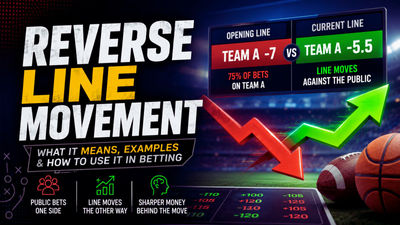
Reverse line movement happens when the line moves against the side receiving most of the bets.
Example:
Market Signal | Situation |
Public bets | 75% of tickets on Team A |
Expected move | Team A -3 to Team A -4 |
Actual move | Team A -3 to Team A -2.5 |
Possible meaning | Sharp money may be on Team B |
This looks strange to beginners. If most bettors are backing Team A, why would the line move toward Team B?
The answer is that sportsbooks may be reacting to respected money on Team B, even if the majority of tickets are on Team A.
Reverse line movement is not proof that Team B will win or cover. It is a signal that the market may be respecting the unpopular side.
Understanding Betting Splits: Money vs Bet Percentage
Betting splits show how bets and money are distributed across a market.
There are two main numbers to understand:
Bet percentage: the percentage of individual bets placed on a side
Money percentage: the percentage of total money wagered on a side
These are not the same thing.
A team can receive most of the bets but not most of the money. That often means many smaller recreational bets are on that side.
Another team can receive fewer bets but more total money. That may suggest larger or sharper wagers are on that side.
Simple Betting Splits Example
Side | Bet Percentage | Money Percentage | Possible Interpretation |
Team A | 80% | 45% | Many small public bets |
Team B | 20% | 55% | Fewer bets, larger money |
In this example, Team A is the public side. Most bettors are backing Team A.
But Team B has more of the total money despite fewer tickets. That may suggest sharper or larger bettors are backing Team B.
This does not mean Team B is guaranteed to be the right side. It simply tells you the betting market is not as one-sided as the ticket count suggests.
Why Bet Percentage Alone Can Mislead
A beginner might see “80% of bets on Team A” and think Team A is the obvious bet.
That can be dangerous.
High bet percentage may simply mean the public likes that side. It does not tell you whether the price is good, whether sharper money is on the same side, or whether the line has already moved too far.
Betting splits are useful only when combined with context.
Ask:
Which side has most tickets?
Which side has most money?
Has the line moved?
Did the move happen early or late?
Was there injury or team news?
Is this a high-volume market or a smaller market?
Has the price already lost value?
Betting splits are market clues, not betting instructions.
Spotting Sharp Money: Practical Signals & Examples
Sharp money is not always visible. Sportsbooks do not publish a list of professional bettors. But certain market signals can suggest sharp action.
These signals should be read carefully. One signal alone is rarely enough. The strongest clues usually appear when several signals point in the same direction.
1. Reverse Line Movement
Reverse line movement is one of the clearest sharp money signals.
Example:
Detail | Market |
Opening spread | Team A -3 |
Public tickets | 78% on Team A |
Line movement | Team A -3 to Team A -2.5 |
Possible signal | Sharp money on Team B |
Most public bets are on Team A, but the line moves toward Team B. That suggests the sportsbook may be reacting to respected action on Team B.
This does not guarantee Team B is a winning bet. But it tells you the market is not simply following public opinion.
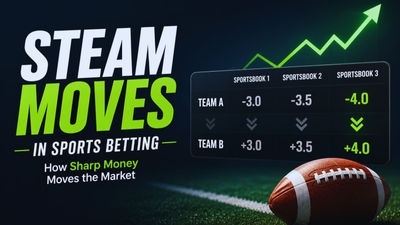
2. Steam Moves
A steam move is a fast, sharp line move across multiple sportsbooks.
Example:
Time | Line |
10:00 AM | Team A -2.5 |
10:08 AM | Team A -3 |
10:15 AM | Team A -3.5 |
If several sportsbooks move quickly in the same direction, it may suggest sharp or syndicate action.
The danger for beginners is chasing the move too late.
If sharp bettors took Team A -2.5 and you enter at Team A -3.5, you are not getting the same bet. You are taking a worse number.
3. Bet Percentage vs Money Percentage Gap
A gap between ticket percentage and money percentage can suggest sharp action.
Example:
Side | Bet % | Money % |
Team A | 72% | 38% |
Team B | 28% | 62% |
This may indicate public bettors are on Team A, while larger or sharper money is on Team B.
Again, it is not automatic proof. Large money can also come from wealthy recreational bettors. But the gap is worth studying.
4. Early Line Movement
Sharp bettors often act early, especially when opening lines are softer.
Example:
Stage | Line |
Opening line | Team A +5.5 |
Early sharp action | Team A +5.5 taken quickly |
New line | Team A +4.5 |
If the line moves early before public betting volume builds, it may suggest sharp bettors spotted a mispriced number.
Public betting usually peaks closer to game time, especially around major events. Early movement is more likely to be linked to sharper market action, although news can also cause early movement.
5. Line Freezing
Line freezing happens when heavy public betting comes in on one side, but the sportsbook does not move the line as expected.
Example:
Detail | Market |
Public action | 80% of tickets on Team A |
Expected move | Team A -4 to Team A -5 |
Actual move | Line stays at Team A -4 |
Possible meaning | Sportsbook may be comfortable needing Team B |
This can suggest the sportsbook does not fear the public side, or that respected money has already come in on the other side.
Line freezing is subtle. It should be used with caution, especially if you do not know the full market context.
6. Sharp Action After News
Sharp bettors often react quickly to news.
Examples:
A star player is ruled out
Weather changes before a football match
A key bowler is unavailable in cricket
A starting goalkeeper is dropped
An NBA player’s minutes limit changes
If a line moves sharply within minutes of news breaking, sharp bettors or automated betting groups may have acted before the public fully reacted.
By the time most beginners notice the move, the best price may already be gone.
Should You Fade the Public or Follow Sharps?
Fading the public means betting against the popular public side.
Following sharps means trying to bet on the same side as respected professional money.
Both ideas can be useful. Both can also be misused.
When Fading the Public Can Make Sense
Fading the public can be useful when public sentiment has pushed the price too far.
For example, if a famous football club is heavily backed by casual bettors, the opposing side or draw may become overpriced. If an NBA favourite receives heavy public betting, the underdog spread may become more attractive.
This is not because the public is always wrong. It is because public betting can sometimes distort prices.
A public side can still win easily. The question is whether the odds are still worth taking.
When Following Sharps Can Make Sense
Following sharp money can be useful when you identify the movement early enough and still get a good price.
For example, if respected bettors take Team B +7 and the line moves to +5.5, following at +5.5 may not offer the same value. The sharp bettors got the better number.
That is why timing matters.
Following sharp money is not just about copying the side. It is about understanding the price.
Why Blindly Following Either Side Is Risky
Beginners often make two mistakes:
They blindly fade the public because they assume the crowd is always wrong.
They blindly follow sharp signals because they assume sharps always win.
Both are weak approaches.
A better process is:
Identify the public side.
Check money percentage and bet percentage.
Look at line movement.
Ask whether there was relevant news.
Compare the current line with the opening line.
Decide whether the current price still has value.
Stake responsibly.
The key idea is expected value. A bet is not good because the public hates it or because sharps liked it earlier. It is good only if the price is better than the true probability.
Common Myths & Misconceptions
Public money and sharp money are useful concepts, but they are often oversimplified.
Myth 1: Sharp Money Always Wins
Sharp money does not always win.
Professional bettors lose individual bets all the time. Their edge comes from price discipline, long-term sample size, and repeatedly finding value.
A sharp bet can lose badly. A public bet can win easily.
One result does not prove the signal was good or bad.
Myth 2: The Public Is Always Wrong
The public is not always wrong.
Sometimes the popular favourite is correctly priced. Sometimes public and sharp money are on the same side. Sometimes the public wins because the obvious side was actually the right side.
Fading the public without checking the price is not sharp. It is just contrarian guessing.
Myth 3: Betting Splits Guarantee Winners
Betting splits do not predict results by themselves.
They show how the market is behaving. That can be useful, but it is only one part of the full picture.
You still need to consider:
Team news
Injuries
Market timing
Current price
Opening price
Bet type
Liquidity
Sport-specific factors
Myth 4: More Money Always Means Sharp Money
A high money percentage can suggest sharper action, but it does not prove it.
A wealthy recreational bettor can place a large bet. A public-heavy market can also have large money on the obvious side.
The best signal is not just “more money.” It is the combination of money percentage, bet percentage, timing and line movement.
Myth 5: Chasing Steam Is the Same as Betting Sharp
Chasing steam can be dangerous.
If a line moved because sharps bet early, the best number may already be gone. Betting the same side after the move may leave you with poor value.
For example, if sharps took Team A -2.5 and you take Team A -4, you are not following the same bet. You are paying a worse price.
Geo Considerations & Responsible Betting
The difference between public money and sharp money is a market concept. It applies globally, but the availability of betting data and legal betting options varies by region.
United States
The US market has strong interest in public money, sharp money, betting splits and reverse line movement. Bettors often see these ideas discussed around NFL, NBA, MLB, college football and college basketball.
US bettors should remember that sports betting rules vary by state. Use only legal and regulated options where available.
United Kingdom
UK bettors may see similar concepts discussed around football, horse racing, tennis and major sports markets. The wording may differ, but the idea is the same: recreational money and respected money can influence pricing differently.
UK bettors should also remember that odds format, exchange betting and bookmaker margin can affect how market signals appear.
India
For Indian readers, this guide should be treated as educational content. Sports betting is heavily restricted or illegal in many Indian states, and the legal position varies by location.
The concept of public money vs sharp money can help explain global betting markets, but it should not be taken as advice to place bets where betting is not legally permitted.
Wherever you live, bet only where it is legal, use money you can afford to lose, and avoid treating any market signal as a guarantee.
If you are still learning the basics, it may help to understand the types of sports betting before trying to interpret public money, sharp money or betting split data.
Conclusion & Key Takeaways
Public money and sharp money describe who is betting, how they bet, and how sportsbooks may react.
Public money usually comes from casual bettors who prefer popular teams, favourites, overs and narrative-driven bets. Sharp money usually comes from professional or disciplined bettors who focus on price, probability and long-term value.
The difference matters because sharp action can influence line movement, while public action can sometimes inflate prices on popular sides.
The practical takeaway is simple: do not blindly follow the public, and do not blindly follow sharps. Use betting splits, line movement, reverse line movement and timing as market clues. Then ask the most important question: is the current price still worth taking?
FAQs
What is public money in sports betting?
Public money is betting money that comes from casual or recreational bettors. It often goes toward popular teams, favourites, overs, star players and outcomes influenced by media narratives or fan loyalty.
What is sharp money in betting?
Sharp money is betting money from professional, semi-professional or highly disciplined bettors. Sharp bettors usually use data, price analysis and market timing to find value in mispriced odds.
What’s the difference between sharp and public money?
Sharp money is usually professional, value-driven and more influential on line movement. Public money is usually recreational, more emotional and often concentrated on popular teams, favourites and overs.
How can you tell when sharp money is on a side?
You can look for signals such as reverse line movement, steam moves, early line movement, and gaps between bet percentage and money percentage. No single signal proves sharp action, but several signals together can be meaningful.
Does sharp money always win?
No, sharp money does not always win. Sharp bettors lose individual bets too. Their advantage comes from finding better prices over time, not from predicting every result correctly.
Is fading the public a good strategy?
Fading the public can be useful when public betting has pushed a line too far, but it is not a strategy by itself. You still need to check price, timing, line movement and whether the current odds offer value.
What are betting splits?
Betting splits show how bets and money are divided across each side of a market. Bet percentage shows the number of individual bets, while money percentage shows the total amount wagered.
Can the public be right?
Yes, the public can be right. Public bettors can win, and popular sides can be correctly priced. The mistake is assuming the public is always wrong or that every public-heavy bet should be faded.
Why do sportsbooks move lines based on sharp money?
Sportsbooks move lines based on sharp money because respected bettors can reveal mispriced odds. A sportsbook may react quickly to sharp action to reduce risk and move the line closer to the true market price.