
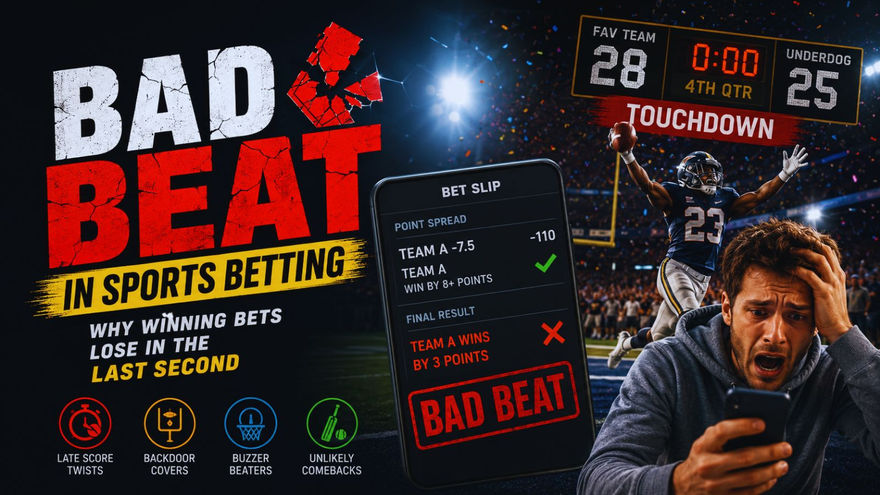
A bad beat in sports betting is when a bet that looked almost certain to win ends up losing because of a late, unlikely, or frustrating twist.
It could be a garbage-time touchdown, a last-second three-pointer, a run-out in cricket, a late penalty in football, or one strange play that changes the betting result.
In simple terms:
A bad beat is a painful betting loss that happens after your bet looked all but won.
Bad beats feel worse than normal losses because they create emotional whiplash. One moment, the ticket looks safe. The next, a late score, fluke play, or unexpected decision turns the result against you.
This guide explains what bad beats mean, why they happen, the kinds of bad beat stories bettors remember, and the psychology behind the frustration. It also explains how to deal with a bad beat without chasing losses or making emotional betting decisions.
Why Do Bad Beats Happen?
Bad beats happen because sport is unpredictable and betting results often depend on details beyond the final winner.
A team can win the match but fail to cover the spread. A game can look safely under the total, then explode with late points. A player can miss a free throw, concede a penalty, bowl one poor over, or make one strange decision that flips the bet.
That is why bad beats are common in spread betting, totals, player props, parlays, and live betting.
Here are the most common causes.
Garbage-Time Scores
Garbage time refers to the final part of a game when the winner is almost decided, but the betting result is still alive.
For example, suppose you bet a basketball favourite -8.5. Your team leads by 10 with 12 seconds left. The opponent makes a meaningless layup at the buzzer.
The favourite still wins the game, but only by 8.
The game result did not matter anymore. The betting result still did.
For fans, that final basket may be irrelevant. For bettors, it can turn a winning ticket into a losing one.
Backdoor Covers
A backdoor cover happens when a team that was not likely to cover the spread scores late and unexpectedly covers.
Example:
Team A is favoured by 10.5 points.
Team A leads by 17 late in the fourth quarter.
Team B scores a late touchdown against backups.
Team A wins by 10.
Team B covers +10.5.
For Team A bettors, that is a classic bad beat. Their team won comfortably, but the spread bet lost at the end.
Backdoor covers are one reason spread bettors cannot relax until the final whistle, buzzer, or last ball.
Miracle Plays
Some bad beats come from plays that feel almost impossible.
These include:
Hail Mary touchdowns
Full-court or half-court buzzer-beaters
Lateral plays on the final snap
Pick-sixes as time expires
Own goals
Last-ball sixes in cricket
Walk-off home runs
Penalties after VAR review
These plays are rare, but they happen often enough that every regular bettor eventually sees one.
That is why a bet can be well reasoned and still lose in a painful way.
Totals That Flip Late
Bad beats also happen on over/under bets.
Suppose you bet under 47.5 points in an NFL game. The score is 24-20 with one minute left. The under looks likely. Then there is a defensive touchdown, a long kick return, or a late score after a turnover.
Suddenly, the final score lands over the total.
Nothing about your original analysis may have been careless. The final sequence simply changed the market result.
That is part of betting variance.
Parlays and Final-Leg Pain
Bad beats feel especially brutal in parlays because one leg can ruin the entire ticket.
Imagine a five-leg parlay. Four legs have already won. The final leg is a heavy favourite leading late. Then one mistake, one red card, one run-out, or one late equaliser destroys the whole bet.
That is why understanding risk in a parlay bet matters. Every extra leg adds another way for something unusual to happen.
Bad Beat Stories Across Sports
Bad beats can happen in any sport, but they often look different depending on the market.
Some are caused by spreads. Some are caused by totals. Some come from props or parlays. The common thread is the same: the bettor felt the result was nearly settled before it suddenly changed.
NFL Bad Beat: The Late Touchdown That Changes the Spread
NFL spreads are famous for bad beats.
Imagine you bet a favourite at -6.5. The team leads by 10 with under a minute left. The opponent cannot realistically win, but they keep playing.
Then the underdog scores a late touchdown.
The favourite still wins the game, but only by 3.
The scoreboard says your team won. Your betting slip says you lost.
That is one reason NFL bettors pay attention to the spread until the final whistle. A late score that means nothing to the standings can mean everything to the bet.
College Football Bad Beat: The Desperation Lateral
College football can produce extreme bad beats because teams often attempt wild final plays.
Picture an underdog at +3.5. They trail by 3 on the final play. A normal tackle would mean they cover. Instead, they try laterals, fumble, and the defence returns it for a touchdown.
The final margin jumps from 3 to 9.
The underdog bettor goes from winning the spread to losing it after a play that was almost meaningless for the actual winner of the game.
That is the kind of ending bettors remember for years.
NBA or NCAA Basketball Bad Beat: The Buzzer-Beater That Should Not Matter
Basketball bad beats often happen because players keep shooting until the final second.
Suppose a favourite is -4.5 and leads by 6 with two seconds left. The opponent throws up a deep three-pointer at the buzzer. It goes in.
The favourite wins by 3.
To fans, it is just a late shot in a decided game. To bettors, it completely changes the result.
This is why basketball spreads can feel emotionally intense. Even when the game winner is clear, the spread may not be safe.
MLB Bad Beat: Extra Innings Break the Under
Baseball totals can produce slow, painful bad beats.
Imagine you bet under 7.5 runs. The game is 2-2 after nine innings. The under still looks good.
Then extra innings begin, bullpens struggle, and both teams score multiple runs.
The game finishes 6-5.
The bet that looked safe for nine innings loses because the game kept going.
This is not automatically bad analysis. Extra innings, bullpen fatigue, and late-game variance are simply part of baseball betting.
WNBA Bad Beat: Heavy Favourite Busts the Final Leg
Bad beats are not limited to major men’s leagues.
Suppose a bettor has a high-paying parlay with one leg remaining. The final leg is a heavy WNBA favourite against a weaker team. The odds are short, and the bettor assumes it is the safest part of the ticket.
Then the favourite loses outright.
This is a painful reminder that heavy favourites can lose in any sport. A short price is not the same as a guarantee.
Football Bad Beat: Late Penalty or VAR Twist
Football bettors often suffer bad beats from late penalties, red cards, own goals, or VAR decisions.
Example:
You bet under 2.5 goals. The score is 1-1 in stoppage time. The match looks finished. Then VAR awards a penalty after a handball review. The penalty is scored, and the final result becomes 2-1.
The over wins. The under loses.
For the bettor, it feels cruel because the game seemed nearly done. But in football, one late decision can change everything.
Cricket Bad Beat: A Collapse From a Winning Position
Cricket creates its own version of bad beats.
Suppose you back a team chasing 145. They need 18 runs from 24 balls with seven wickets in hand. The bet looks almost finished.
Then comes a run-out, a wicket from a poor shot, a brilliant over, and pressure on the lower order. Suddenly, the chase collapses.
The team loses by a few runs.
That is a cricket bad beat. The bettor was not wrong that the team was in control. But control is not certainty.
Emotional Impact & Psychology of Bad Beats
Bad beats hurt because they feel different from ordinary losses.
If your bet is losing from the first quarter, first innings, or first half, you have time to accept it. A bad beat gives you the opposite experience. It lets you believe you have won, then takes it away.
That emotional swing is what makes bad beats memorable.
Why Bad Beats Feel So Personal
A bad beat often triggers thoughts like:
“I was right.”
“That should never have happened.”
“I deserved to win.”
“The result was stolen from me.”
“I need to get that money back.”
These thoughts are understandable, but they can become dangerous if they lead to emotional betting.
A bad beat feels unfair because the final event is usually unlikely. But unlikely does not mean impossible. Betting is full of low-probability events.
Common Biases After a Bad Beat
Bad beats can trigger several mental shortcuts.
Bias | What It Looks Like After a Bad Beat |
Loss aversion | The loss feels more painful than a normal win feels good |
Recency bias | You overreact to the latest painful result |
Confirmation bias | You search for evidence that you were “robbed” |
Gambler’s fallacy | You think you are “due” a win after a bad loss |
Overconfidence | You believe your pick was perfect and ignore risk |
Anchoring | You fixate on the moment when the bet looked won |
These reactions are human. The key is recognising them before they change your next decision.
Tilt in Betting
Tilt is an emotional state where frustration, anger, or disappointment leads to poor betting decisions.
After a bad beat, tilt may look like:
Placing another bet immediately
Increasing your stake to recover the loss
Betting on a market you do not understand
Chasing live bets impulsively
Adding extra parlay legs for a bigger payout
Ignoring your normal bankroll rules
Betting because you are angry, not because the price is good
Tilt is not a strategy problem. It is an emotional control problem.
Emotional Triggers to Watch
Bad beats are not the only trigger for emotional betting, but they are one of the strongest.
Other triggers include:
A lucky win that creates ego
Boredom
Stress
Drinking alcohol
Betting on your favourite team
A losing streak
Social pressure from friends or betting groups
Seeing others post winning slips online
The danger is not feeling emotion. That is normal.
The danger is letting emotion decide your next bet.
Warning Signs You Are Betting Emotionally
You may be drifting into emotional betting if:
You increase stakes after a loss
You bet faster than usual
You stop comparing odds
You feel you “need” to win the money back today
You ignore your planned betting limits
You bet on sports or markets you normally avoid
You feel restless when you are not betting
You hide betting activity from people close to you
These signs do not mean someone is a bad bettor. They mean it may be time to pause.
Tilt & Coping Strategies
Bad beats are unavoidable. The goal is not to eliminate them. The goal is to stop them from damaging your decision-making.
Here are practical ways to handle a bad beat.
1. Pause Before Placing Another Bet
The first few minutes after a bad beat are usually the worst time to make a new decision.
Your mind wants relief. Betting again can feel like a way to fix the frustration. That is how chasing begins.
A simple rule helps:
After a bad beat, wait at least 15–30 minutes before placing another bet.
For bigger losses, wait longer. Sometimes the best decision is to stop for the day.
2. Stick to Your Bankroll Rules
A bad beat should not change your staking plan.
If your normal stake is $10, it should not become $50 because of one painful loss.
This is where bankroll management matters. Your bankroll rules exist for exactly these moments. They protect you when your emotions are strongest.
Good bankroll habits include:
Setting a fixed unit size
Avoiding sudden stake increases
Setting daily or weekly loss limits
Tracking results honestly
Not chasing losses
Accepting that variance is part of betting
3. Review the Bet Later, Not Immediately
Right after a bad beat, it is hard to be objective.
Review the bet later when the emotion has settled.
Ask:
Was the original bet well reasoned?
Was the price good?
Did I understand the market?
Was the loss caused by variance or poor judgement?
Did I stake too much?
Would I make the same bet again at the same odds?
This helps separate a bad result from a bad decision.
4. Focus on Process, Not One Result
A single bad beat does not prove your betting process is wrong.
The better question is whether your decisions make sense over time.
That is where value betting becomes useful. A value bet can still lose. The goal is not to win every ticket. The goal is to make decisions where the odds are better than the true probability over a large sample.
Bad beats are painful because they feel personal. But long-term betting is not judged by one painful result.
5. Avoid Alcohol or High-Stress Betting
Bad beats become more dangerous when combined with stress, tiredness, or alcohol.
These states lower patience and increase impulsive decisions.
If you notice that you make worse bets late at night, after drinking, or after a difficult day, set stricter rules for those situations.
Example:
No live betting after a bad beat.
No betting after drinking.
No increasing stakes after 10 PM.
No parlays after a losing day.
Simple rules can prevent expensive mistakes.
6. Use a Short Coping Routine
A coping routine helps you slow down.
After a bad beat, try this:
Close the betting app.
Write down what happened in one sentence.
Mark whether the bet was good process or poor process.
Wait before betting again.
Return only if the next bet fits your normal rules.
This may sound basic, but it works because it creates distance between emotion and action.
7. Know When to Stop
The best bettors are not emotionless. They are disciplined enough to stop when they are no longer thinking clearly.
Stop betting for the day if:
You are angry
You are chasing
You want revenge on the market
You are increasing stakes impulsively
You are betting markets you do not normally follow
You cannot accept the loss
Stopping is not weakness. It is risk control.
Responsible Betting & Final Thoughts
Bad beats are part of sports betting.
They happen because sport is unpredictable, betting markets are sensitive to tiny details, and late events can change spreads, totals, props, and parlays. A bad beat can be frustrating, but it should not change your entire betting approach.
The practical lesson is simple:
A bad beat is painful, but chasing it usually makes the damage worse.
To handle bad beats better:
Accept that variance is part of betting.
Do not treat one loss as proof of bad luck or unfairness.
Keep stakes consistent.
Avoid emotional betting.
Take breaks after painful losses.
Review decisions calmly.
Focus on process, odds, and value.
Bet only with money you can afford to lose.
Legal context also matters. Sports betting rules differ by region. In the US, betting laws vary by state. In the UK, betting is regulated but still requires responsible habits. In India, sports betting is restricted or illegal in many states, so this guide should be treated as educational unless betting is legal where you live.
If you are still learning, it may help to understand the types of sports betting, how betting odds work, and how bookmaker margin such as vig or juice affects long-term results.
You can also explore the history of sports betting to see how unpredictability has always been part of betting markets.
Bad beats will happen. The real test is what you do next.
FAQs
What is a bad beat?
A bad beat is when a bet that looked almost certain to win ends up losing because of an unlikely late event. It often happens through a garbage-time score, buzzer-beater, backdoor cover, or other last-second twist.
Why do bad beats happen in sports betting?
Bad beats happen because sports are unpredictable and betting markets depend on details like spreads, totals, props, and timing. A late score or fluke play may not change the match winner, but it can still change the betting result.
How do I cope with a bad beat?
The best way to cope with a bad beat is to pause, avoid chasing, stick to your bankroll rules, and review the bet later when you are calmer. Do not increase your stake just because a painful loss feels unfair.
What is tilt in betting?
Tilt in betting is an emotional state where frustration or anger leads to irrational decisions. After a bad beat, tilt can cause bettors to chase losses, raise stakes, or place rushed bets they would normally avoid.
Are bad beats common?
Bad beats are part of sports betting, especially for people who bet often. They do not happen every day, but over enough bets, every bettor will eventually experience painful late swings.
What is gambler’s fallacy in betting?
Gambler’s fallacy is the belief that a future outcome is more likely because of what happened recently. For example, after several losing bets, a bettor may think they are “due” a win, even though each event still has its own probability.
What is a backdoor cover?
A backdoor cover happens when a team scores late and unexpectedly covers the spread, even though they were not likely to win the game. It is one of the most common causes of bad beats in spread betting.
Is a bad beat the same as a bad bet?
No. A bad beat is usually a painful loss from a bet that had a strong chance to win late. A bad bet is a poor decision from the start, usually because the price, reasoning, or staking was weak.
Is the term bad beat used in poker too?
Yes. Bad beat is also used in poker, where it usually means a strong hand loses to a weaker hand after an unlikely card or sequence. In sports betting, the idea is similar: a position that looked strong loses because of an improbable twist.