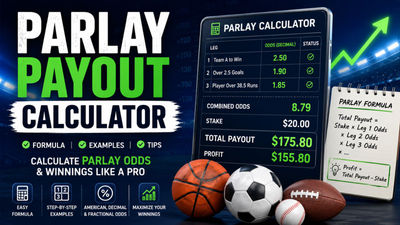

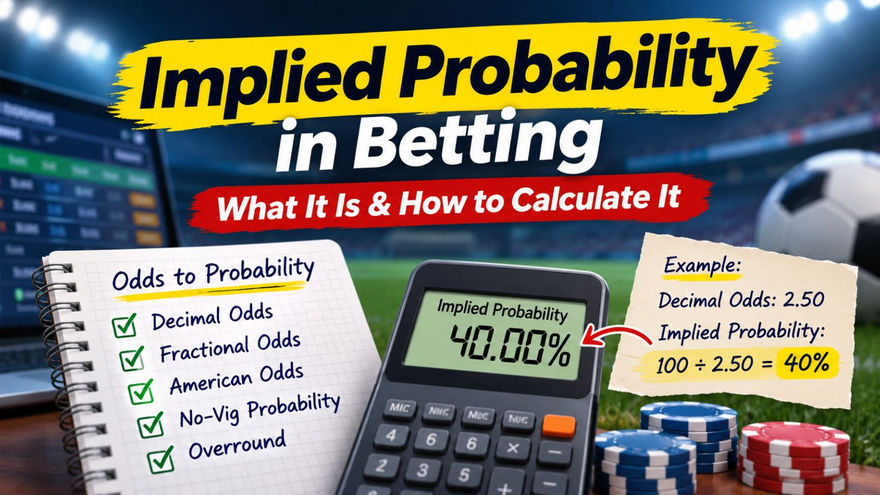
Implied probability is the percentage represented by betting odds. For example - At decimal odds of 2.50, the implied probability is 40%: divide 100 by 2.50.
For an ordinary cash bet that either wins or loses, this is also the win rate needed to break even at that price, before fees or taxes. It does not establish that the selection actually has a 40% chance of winning.
That distinction matters. You can calculate the probability implied by a price exactly. Estimating the real chance of a sporting outcome is a separate, uncertain task.
How to calculate implied probability
The formula depends on the odds format. Each formula below gives a percentage.
Odds format | Formula | Worked example |
Decimal, D | 100 ÷ D | 2.50: 100 ÷ 2.50 = 40% |
Fractional, a/b | b ÷ (a + b) × 100 | 3/2: 2 ÷ 5 × 100 = 40% |
Positive American, +A | 100 ÷ (A + 100) × 100 | +150: 100 ÷ 250 × 100 = 40% |
Negative American, −A | A ÷ (A + 100) × 100 | −150: 150 ÷ 250 × 100 = 60% |
For negative American odds, A means the positive size of the number. With −150, enter 150 into the formula, not −150.
You can also enter a price into TBP's odds converter to compare formats.
Decimal odds
Decimal odds include the returned stake. A hypothetical 10-unit winning bet at 2.50 returns 25 units in total: the original 10 plus 15 profit.
The implied probability is therefore 10 ÷ 25 = 0.40, or 40%. You get the same answer from 1 ÷ 2.50, regardless of the stake.
Do not divide by 1.50, the profit portion of the price. The calculation uses the total-return odds, 2.50.
Fractional odds
Fractional odds describe profit relative to stake. At 3/2, a winning 2-unit bet earns 3 units of profit and returns 5 units in total.
Divide the stake portion by the combined stake and profit: 2 ÷ (3 + 2) = 40%.
Simply dividing 3 by 2 calculates the profit multiple, not the implied probability.
American odds
Positive American odds show the profit on a 100-unit stake. At +150, that stake returns 250 units if it wins. The implied probability is 100 ÷ 250 = 40%.
Negative American odds show the stake needed to make 100 units of profit. At −150, a 150-unit stake returns 250 units if it wins. The calculation is 150 ÷ 250 = 60%.
The signs change how the price is written. They do not represent positive or negative probabilities.
Common odds and their implied probabilities
Decimal | Fractional | American | Implied probability |
1.25 | 1/4 | −400 | 80% |
1.50 | 1/2 | −200 | 66.67% |
2.00 | 1/1 | +100 | 50% |
2.50 | 3/2 | +150 | 40% |
3.00 | 2/1 | +200 | 33.33% |
5.00 | 4/1 | +400 | 20% |
Percentages are rounded to two decimal places where needed. Shorter decimal odds imply a higher probability and offer less profit for the same winning stake. Longer odds imply a lower probability and offer more profit.
The formats are different ways of expressing the same price. Changing 2.50 to +150 does not change the implied probability.
Why implied probability is a break-even threshold
Take 100 hypothetical bets, each staking 10 units at exactly 2.50. Assume every bet either wins in full or loses in full, with no refunds, commission or taxes.
The total amount staked is 1,000 units. If 40 bets win, each returns 25 units, producing total returns of 1,000 units. Profit is zero.
The same result appears when counting profit and losses: 40 wins earn 600 units of profit, while 60 losses cost 600 units.
This illustrates the 40% break-even threshold. It is not a prediction that exactly 40 of the next 100 bets will win. Actual results fluctuate, and changing prices mean there is no single threshold for a mixed set of bets.
Why a market's probabilities can add up to more than 100%
Suppose a hypothetical two-outcome market offers 1.90 on both sides, with exactly one side winning and no draw or refund.
Each side implies 100 ÷ 1.90 = 52.63%. Together, using unrounded figures, they total 105.26%.
The excess above 100% is called the overround. Here it is 5.26 percentage points, conventionally described as a 5.26% overround.
Overround describes the quoted prices. It is not a guaranteed bookmaker profit percentage: actual returns depend on the stakes accepted and results. Discusses the role of balanced liability. TBP's guide to how betting sites make money explains the wider business model.
To calculate a meaningful market total, include every outcome that can settle as the winner, with no overlap. Use prices from the same bookmaker and time. For a three-way football match-result market, include home win, draw and away win. Two teams alone leave the draw missing.
For more on the terminology, see vig or juice in betting.
How to calculate no-vig probability
One simple way to remove the excess mathematically is proportional normalization: divide each raw implied probability by the sum of all the implied probabilities.
Consider this hypothetical three-way market:
Outcome | Decimal odds | Raw implied probability | Proportional no-vig estimate |
Home win | 2.20 | 45.45% | 43.22% |
Draw | 3.40 | 29.41% | 27.97% |
Away win | 3.30 | 30.30% | 28.81% |
Total | 105.17% | 100.00% |
For the home win, the calculation uses unrounded numbers:
(1 ÷ 2.20) ÷ [(1 ÷ 2.20) + (1 ÷ 3.40) + (1 ÷ 3.30)] × 100 = 43.22%.
The method scales all three numbers down by the same proportion. It assumes the excess is distributed proportionally across the outcomes. Other adjustment methods can produce different estimates.
A no-vig estimate is therefore a model-based reading of the prices. It does not reveal the true probability, and forcing the total to 100% does not prove that any individual outcome is correctly priced.
The raw 45.45% remains the break-even threshold for the offered home-win price of 2.20 under the ordinary win/loss assumptions. Normalizing the market does not change that payout.
Does a lower implied probability mean a better bet?
A lower implied probability means a higher payout at the quoted odds. It does not, by itself, mean better value.
Suppose a price of 2.50 implies 40%, while your own analysis estimates the selection's chance at 45%. If that estimate is accurate, the expected net return per unit staked is:
0.45 × 2.50 − 1 = 0.125 units.
That is a theoretical 12.5% expected return under the stated assumptions, not a promised return or the probability of winning. The difference between 45% and 40% is five percentage points; it is not the same quantity as expected return.
The difficult part is supporting the 45% estimate. An opinion does not become reliable because it is entered into a formula. Read the value-betting guide for that separate concept.
Checks before using the result
Check the market. Regulation-time win, qualification and draw-no-bet are different propositions. A percentage only helps if you know what result the price covers.
Check the settlement possibilities. The basic break-even explanation assumes a full win or full loss. Refunds, partial settlements, dead heats and promotional bets need additional calculations. If a bet can push with a full stake refund, 1 ÷ decimal odds describes the break-even win share among bets that resolve as wins or losses, before costs; it is not automatically the unconditional chance of winning.
Check costs. Exchange commission can reduce net winnings. For a single isolated back bet with commission rate c on net winnings, effective decimal odds are 1 + (D − 1) × (1 − c). Actual commission may depend on the net market result and account terms.
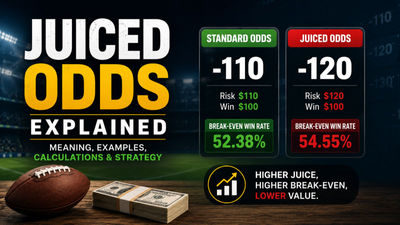
Keep rounding until the end. American −110 implies 52.38%. Its exact decimal equivalent is about 1.90909; converting a rounded 1.91 gives 52.36%. That small difference comes from rounding.
Frequently asked questions
Does changing my stake change implied probability?
No. At an unchanged price, the implied probability stays the same. A larger stake changes the money at risk and potential return, not the percentage represented by the odds.
Can I convert a probability back into decimal odds?
Yes. Divide 100 by the percentage: 100 ÷ 40 = 2.50. If the percentage is your own estimate, the result is the fair price under that estimate. It does not validate the estimate or establish that a bookmaker will offer that price.
Understanding the calculation helps you interpret a price. It cannot remove uncertainty or make gambling a reliable source of income.