
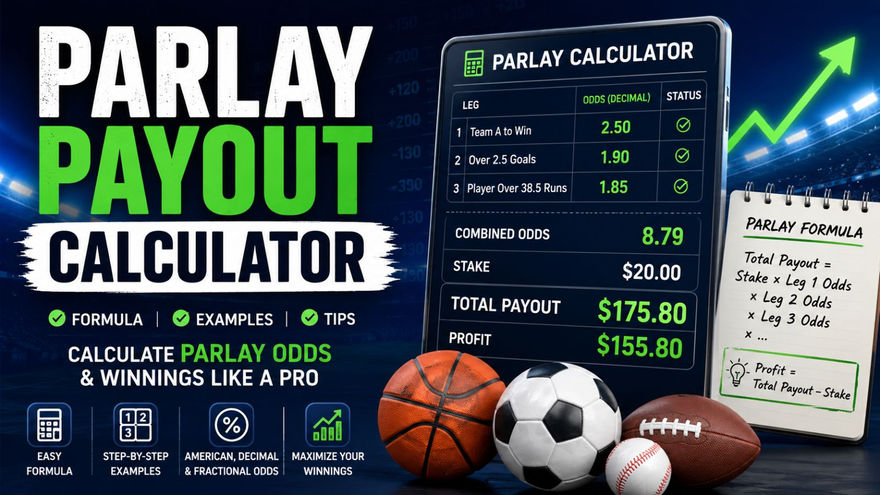
To calculate a parlay payout, convert each leg’s odds into decimal odds, multiply those decimal odds together, and then multiply the result by your stake.
The basic formula is:
Parlay payout = Stake × Leg 1 decimal odds × Leg 2 decimal odds × Leg 3 decimal odds
A parlay bet combines two or more selections into one wager. Every leg must win for the parlay to pay. If one leg loses, the full parlay usually loses.
That is why parlays can show much larger possible returns than single bets. The odds multiply together. But the risk also increases because every selection must be correct.
Before using the formula, keep two terms clear:
Term | Meaning |
Total payout | Your original stake plus your profit |
Profit | The amount you win after subtracting your original stake |
For example, if you stake $10 and the total payout is $75, your profit is $65.
Bet Type | How It Pays |
Single bet | One selection must win |
Parlay bet | Every selection must win |
Parlay payout | Each leg’s odds are multiplied together, then applied to your stake |
The key point is simple: parlay payouts are multiplied, not added.
How Parlay Payouts Are Calculated
A parlay payout is calculated in three steps:
Convert every leg into decimal odds.
Multiply all decimal odds together.
Multiply the combined decimal odds by your stake.
Then, if you want to know your profit, subtract your original stake.
Parlay Payout Formula
Use this formula:
Total payout = Stake × Leg 1 decimal odds × Leg 2 decimal odds × Leg 3 decimal odds
Then use this formula for profit:
Profit = Total payout - Stake
Example:
You place a $20 parlay with three legs.
Leg | Decimal Odds |
Leg 1 | 1.91 |
Leg 2 | 2.20 |
Leg 3 | 1.80 |
Calculation:
$20 × 1.91 × 2.20 × 1.80 = $151.27 total payout
Profit:
$151.27 - $20 = $131.27 profit
This is the cleanest way to calculate parlay payouts because decimal odds already include your stake in the return.
Why Decimal Odds Make Parlays Easier
Decimal odds show the total return for every $1 staked.
Decimal Odds | Meaning |
1.50 | $1 returns $1.50 |
2.00 | $1 returns $2.00 |
3.00 | $1 returns $3.00 |
If your sportsbook already shows decimal odds, you do not need to convert anything. You simply multiply the decimal odds together and then multiply by your stake.
The conversion step is needed when odds are shown in American format, such as +150 or -110, or fractional format, such as 3/2 or 5/4.
Converting Moneyline Odds to Decimal
Many sportsbooks, especially in the US, show odds in American moneyline format.
To calculate a parlay payout manually, you first need to convert those moneyline odds into decimal odds.
Positive Moneyline Odds
Positive moneyline odds show how much profit you would win from a $100 stake.
Formula:
Decimal odds = (American odds / 100) + 1
Examples:
American Odds | Decimal Conversion | Decimal Odds |
+100 | (100 / 100) + 1 | 2.00 |
+150 | (150 / 100) + 1 | 2.50 |
+200 | (200 / 100) + 1 | 3.00 |
+300 | (300 / 100) + 1 | 4.00 |
So, if one parlay leg is +150, the decimal version is:
(150 / 100) + 1 = 2.50
Negative Moneyline Odds
Negative moneyline odds show how much you need to stake to win $100 profit.
Formula:
Decimal odds = (100 / absolute value of American odds) + 1
Examples:
American Odds | Decimal Conversion | Decimal Odds |
-110 | (100 / 110) + 1 | 1.91 |
-120 | (100 / 120) + 1 | 1.83 |
-150 | (100 / 150) + 1 | 1.67 |
-200 | (100 / 200) + 1 | 1.50 |
So, if one parlay leg is -110, the decimal version is:
(100 / 110) + 1 = 1.91
This conversion matters because American odds cannot be multiplied directly. You cannot calculate a parlay by multiplying +150 × -110. Convert each leg first, then multiply the decimal odds.
Converting Fractional & Decimal Odds
In the UK and Ireland, parlays are usually called accumulators or accas. The payout logic is the same, but the odds are often shown in fractional format.
Fractional odds show profit relative to stake.
Fractional Odds | Meaning | Decimal Odds |
1/1 | Win $1 profit for every $1 staked | 2.00 |
3/2 | Win $3 profit for every $2 staked | 2.50 |
5/4 | Win $5 profit for every $4 staked | 2.25 |
2/1 | Win $2 profit for every $1 staked | 3.00 |
Formula:
Decimal odds = (Numerator / Denominator) + 1
Example:
3/2 = (3 / 2) + 1 = 2.50
Once you convert fractional odds to decimal, the parlay payout formula is the same:
Stake × Decimal odds × Decimal odds × Decimal odds
So, whether you call it a parlay, accumulator, acca, or multi bet, the payout math works the same way.
Manual Parlay Payout Formula & Examples
The easiest way to understand parlay payouts is to work through the numbers.
Example 1: Two-Leg Parlay Payout Calculation
Suppose you place a $50 parlay with two legs.
Leg | American Odds | Decimal Odds |
Team A moneyline | +200 | 3.00 |
Team B spread | -110 | 1.91 |
Step 1: Convert the odds.
+200 becomes 3.00
-110 becomes 1.91
Step 2: Multiply the decimal odds.
3.00 × 1.91 = 5.73
Step 3: Multiply by your stake.
$50 × 5.73 = $286.50 total payout
Step 4: Subtract your stake to find profit.
$286.50 - $50 = $236.50 profit
Calculation Step | Result |
Combined decimal odds | 5.73 |
Stake | $50 |
Total payout | $286.50 |
Profit | $236.50 |
This does not mean the bet is likely to win. It only shows what the return would be if both legs win.
Example 2: Three-Leg Parlay Payout Example
Suppose you place a $10 parlay with three legs.
Leg | American Odds | Decimal Odds |
Selection 1 | +150 | 2.50 |
Selection 2 | -120 | 1.83 |
Selection 3 | +200 | 3.00 |
Step 1: Multiply the decimal odds.
2.50 × 1.83 × 3.00 = 13.725
Step 2: Multiply by your stake.
$10 × 13.725 = $137.25 total payout
Step 3: Subtract your stake.
$137.25 - $10 = $127.25 profit
Calculation Step | Result |
Combined decimal odds | 13.725 |
Stake | $10 |
Total payout | $137.25 |
Profit | $127.25 |
This is why parlays attract bettors. A small stake can create a much larger possible return. The trade-off is that all three selections must win.
Example 3: Decimal Odds Parlay
Suppose your sportsbook already shows decimal odds.
You place a $25 parlay.
Leg | Decimal Odds |
Soccer Over 2.5 goals | 1.90 |
Tennis player to win | 1.75 |
NBA team moneyline | 2.10 |
Calculation:
$25 × 1.90 × 1.75 × 2.10 = $174.56 total payout
Profit:
$174.56 - $25 = $149.56 profit
This is the simplest version because no odds conversion is needed.
Example 4: Cricket Parlay Payout
For Indian and cricket-focused readers, the same formula applies.
Suppose you place a $20 cricket parlay.
Leg | Decimal Odds |
India to win | 1.70 |
India team total over 165.5 runs | 1.90 |
Player A over 38.5 runs | 2.00 |
Calculation:
$20 × 1.70 × 1.90 × 2.00 = $129.20 total payout
Profit:
$129.20 - $20 = $109.20 profit
All three legs still need to win. If India win but the team total goes under 165.5 runs, the parlay loses.
What Happens When a Leg Pushes or Is Voided?
If one leg of a parlay pushes or is voided, many sportsbooks treat that leg as decimal odds of 1.00 and recalculate the parlay with the remaining legs.
A push means the bet lands exactly on the line. For example, if you bet a point spread at -3 and the team wins by exactly 3, that leg may push.
A void usually happens when an event is cancelled, postponed beyond the sportsbook’s rules, or a player does not participate in a player prop market.
Example:
You place a three-leg parlay.
Leg | Decimal Odds | Result |
Leg 1 | 1.91 | Wins |
Leg 2 | 2.20 | Push |
Leg 3 | 1.80 | Wins |
If Leg 2 is graded as 1.00, the new calculation becomes:
Stake × 1.91 × 1.00 × 1.80
With a $20 stake:
$20 × 1.91 × 1.00 × 1.80 = $68.76 total payout
Without the push, the original payout would have been:
$20 × 1.91 × 2.20 × 1.80 = $151.27 total payout
A push usually does not lose the parlay, but it reduces the payout because that leg no longer adds extra odds.
House rules vary. Always check how your sportsbook handles pushes, voids, postponed matches, and player prop rules before placing the bet.
Fixed-Odds Parlay Payout Chart
Some sportsbooks, especially older retail sportsbooks, use fixed payout charts for standard spread or totals parlays. These charts often assume common prices such as -110 on each leg.
Exact payouts vary by sportsbook, but a typical fixed-odds parlay chart may look like this:
Parlay Size | Approximate Fixed-Odds Payout |
3-team parlay | 5.5 to 1 |
4-team parlay | 11 to 1 |
5-team parlay | 22 to 1 |
6-team parlay | 44 to 1 |
7-team parlay | 88 to 1 |
8-team parlay | 175 to 1 |
9-team parlay | 350 to 1 |
10-team parlay | 700 to 1 |
“5.5 to 1” means a $10 stake would win $55 profit. With the original $10 stake returned, the total return would be $65.
But payout charts are not the same as true mathematical probability. Sportsbooks build margin into the odds. That margin is called vig or juice.
That is why a fixed-odds parlay may pay less than its true fair price. The more legs you add, the more that margin can matter.
Using Parlay Calculators
A parlay calculator does the math automatically. You enter the stake and the odds for each leg, and the calculator shows the potential payout.
A typical parlay calculator asks for:
Your stake
Each leg’s odds
Odds format: American, decimal, or fractional
Number of legs
Total payout
Profit
Calculators are useful because they reduce manual mistakes. They are especially helpful when your parlay includes mixed odds, such as +150, -120, and 2.10.
Still, it helps to know the formula. A calculator can show the payout, but understanding the math helps you see why the payout changes when you add legs, remove legs, accept shorter odds, or deal with a push.
Use a calculator for speed. Use the manual formula for understanding.
Factors Affecting Parlay Payouts
The formula is simple, but the final payout depends on more than the number of legs. Odds, vig, line movement, house rules, and bet type all matter.
1. Number of Legs
Adding more legs usually increases the payout because more odds are multiplied together.
It also lowers the chance of winning because more selections must land.
Parlay Size | What Must Happen |
2-leg parlay | 2 selections must win |
4-leg parlay | 4 selections must win |
8-leg parlay | 8 selections must win |
A bigger payout does not automatically mean a better bet. It usually means more risk.
2. Odds of Each Leg
A parlay with underdogs pays more than a parlay with heavy favourites.
Parlay Type | Expected Payout |
Three favourites at 1.40 each | Lower payout |
Three even-money legs at 2.00 each | Higher payout |
Three underdogs at 3.00 each | Much higher payout |
Higher odds usually mean lower probability. A large payout should always be compared with how difficult the bet is to win.
3. Vig or Juice
Vig is the sportsbook’s margin.
For example, two sides of a market may both be priced at -110. If both sides were truly 50/50, fair odds would be closer to +100. The difference is the sportsbook’s edge.
This matters in parlays because the margin can compound across several legs.
A parlay may look attractive because the payout is large, but the true probability of winning may be lower than the payout suggests.
4. Correlated Selections
Correlated selections are legs that are related to each other.
Example:
Team A to win
Team A quarterback over passing yards
Game total over
These outcomes may be connected. If Team A’s offence plays well, all three legs may become more likely together.
Sportsbooks often restrict correlated parlays or adjust the odds. Same-game parlays are built around this idea, but they use sportsbook pricing models rather than simple multiplication.
For this article, the main formula works best for standard parlays with independent legs.
5. Line Movement
If odds change before you place the bet, the payout changes.
Example:
A leg moves from +150 to +120.
Odds | Decimal |
+150 | 2.50 |
+120 | 2.20 |
That one change lowers the total parlay payout.
This is why price shopping and understanding closing line value (CLV) can matter, especially for bettors trying to improve long-term results.
6. House Rules
Parlay rules can vary by sportsbook.
Check how the sportsbook handles:
Pushes
Voided legs
Player props
Same-game combinations
Suspended matches
Cash out offers
Maximum payout limits
Do not assume every sportsbook calculates every parlay in exactly the same way.
Regional & Format Differences
The math behind parlay payouts is the same globally, but terminology and odds formats can differ.
US: Parlays and Moneyline Odds
In the US, the word parlay is standard. Odds are usually shown in American format, such as +150 or -110.
Most payout examples use NFL, NBA, MLB, NHL, or college sports.
The key step for US bettors is converting American odds to decimal before multiplying.
UK: Accumulators and Fractional Odds
In the UK, a parlay is usually called an accumulator or acca.
Fractional odds are common.
Example UK accumulator:
Leg | Fractional Odds | Decimal Odds |
Team A to win | 3/2 | 2.50 |
Team B to win | 5/4 | 2.25 |
Team C to win | 2/1 | 3.00 |
A $10 accumulator payout would be:
$10 × 2.50 × 2.25 × 3.00 = $168.75 total payout
Profit:
$168.75 - $10 = $158.75 profit
The name changes, but the formula does not.
India: Cricket Parlays and Legal Context
In India, many bettors are more familiar with cricket markets. A cricket parlay might include:
Match winner
Team runs total
Player runs
Wickets
Boundaries
Series winner
The payout formula is the same.
Example:
Leg | Decimal Odds |
India to win | 1.70 |
Player A over 38.5 runs | 1.95 |
Total sixes over 11.5 | 2.05 |
With a $10 stake:
$10 × 1.70 × 1.95 × 2.05 = $67.96 total payout
Profit:
$67.96 - $10 = $57.96 profit
For Indian readers, the main caution is legal. Betting laws vary by state and platform. This guide explains the payout math only. Always check local rules before placing any bet.
Pros, Cons & Responsible Considerations
Parlays are popular because they can turn a small stake into a larger possible payout. They are also high-risk because every leg must win.
Pros | Cons |
Higher possible payout from a smaller stake | One losing leg can lose the entire bet |
Simple to understand once you know the formula | Probability drops as legs increase |
Works across sports and markets | Vig can compound across multiple legs |
Useful for combining opinions | Easy to overuse because payouts look attractive |
Can make multiple games more engaging | Can encourage chasing losses |
Why Parlays Can Be Risky
The payout grows quickly because the odds multiply.
But your chance of winning also drops because every leg must land.
For example, even if each leg has a 50% chance of winning:
Number of Legs | Approximate Chance All Win |
2 legs | 25% |
3 legs | 12.5% |
4 legs | 6.25% |
5 legs | 3.125% |
This is before considering vig.
That does not mean nobody should ever place parlays. It means bettors should understand the risk behind the payout.
Bankroll Discipline Matters
A parlay should fit inside your bankroll management plan.
Practical rules:
Keep parlay stakes small.
Avoid adding legs only to make the payout look bigger.
Do not chase losses with larger parlays.
Compare the payout with the true difficulty of winning.
Treat parlays as high-risk bets, not guaranteed profit opportunities.
Think About Value, Not Just Payout
A big payout is not the same as a good bet.
A parlay can have a huge return and still be poor value if the odds are not fair. Understanding value betting helps you judge whether the payout is worth the risk.
Some bettors may also use hedging if they have one leg left in a parlay and want to reduce risk. Hedging is a separate concept, but it is useful once you move beyond basic payout math.
Parlays should be used carefully. The goal is not only to chase a bigger number on the betslip. The goal is to understand the price, the probability, and the risk.
Conclusion & Key Takeaways
To calculate parlay payouts, convert every leg to decimal odds, multiply the decimal odds together, and then multiply by your stake.
The core formula is:
Total payout = Stake × Leg 1 decimal odds × Leg 2 decimal odds × Leg 3 decimal odds
Then:
Profit = Total payout - Stake
The math is straightforward, but the betting decision still needs discipline. Parlays can create large possible payouts, but they also require every leg to win. More legs mean more risk, and vig can reduce long-term value.
Use calculators for speed, but learn the manual formula so you understand what the sportsbook is showing you.
The main lesson is simple: parlay payouts grow through multiplication, but so does the difficulty of winning.
FAQs
How do you calculate parlay payout manually?
You calculate a parlay payout manually by converting each leg’s odds to decimal odds, multiplying all decimal odds together, and then multiplying by your stake. To find profit, subtract your original stake from the total payout.
What is the parlay payout formula for positive and negative odds?
For positive American odds, use (odds / 100) + 1 to convert to decimal. For negative American odds, use (100 / absolute value of odds) + 1. Then multiply the decimal odds together and multiply by your stake.
How do parlay calculators work?
Parlay calculators work by converting each leg’s odds into decimal format, multiplying those odds together, and applying your stake. They usually show both total payout and profit.
What happens if one leg of my parlay pushes?
If one leg pushes, many sportsbooks treat that leg as decimal odds of 1.00 and recalculate the parlay with the remaining legs. This usually reduces the payout but does not automatically lose the parlay.
How much does a 3-team parlay pay?
A 3-team parlay payout depends on the odds of each leg. For example, a $10 parlay with decimal odds of 2.50, 1.83, and 3.00 pays $137.25 total because 2.50 × 1.83 × 3.00 × $10 = $137.25.
How do you calculate parlay payout using fractional odds?
To calculate a parlay payout using fractional odds, first convert each fraction to decimal by dividing the numerator by the denominator and adding 1. For example, 3/2 becomes 2.50. Then multiply all decimal odds by your stake.
Is parlay betting legal in India?
Parlay betting legality in India depends on state laws and the platform being used. This guide explains payout calculation only. Always check local rules before placing any bet.
Can you cash out or hedge a parlay?
Some sportsbooks offer cash out on parlays, but availability depends on the operator and live odds. Hedging means placing another bet to reduce risk on an existing parlay position.