
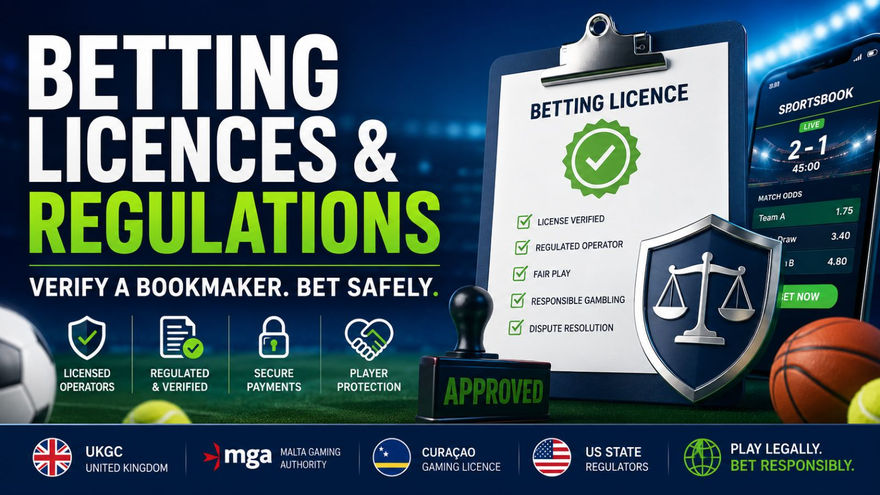
A betting licence is official permission for a bookmaker or sportsbook to offer betting services under a regulator’s rules.
For bettors, that matters because a licensed bookmaker is usually easier to verify, easier to complain about, and more accountable than an unlicensed operator.
A licence does not make betting risk-free. It does not guarantee fast withdrawals, fair odds, or profit. But it can tell you whether the bookmaker is operating under rules for identity checks, customer protection, payment handling, dispute resolution, and responsible gambling.
Before opening an account, the first question should be simple:
Is this bookmaker legally licensed in the country or region where I am betting?
A legal bookmaker should normally have:
A visible licence or regulator reference
A real company name behind the betting brand
Clear terms and conditions
Secure payment and withdrawal rules
Responsible betting tools
A complaints or dispute process
A licence that can be verified on an official regulator website
This guide explains what betting licenses and regulations mean, how to check if a bookmaker is licensed, which major betting licence authorities matter, and what warning signs beginners should avoid.
It is educational information, not legal advice. Sports betting laws vary by country, state and region, so always check the rules where you live before betting.
Major Licensing Authorities & Jurisdictions
A betting licence is only useful if it comes from a real regulator and applies to your location.
A bookmaker may be licensed somewhere, but that does not always mean it can legally accept players everywhere. For example, a sportsbook licensed in one US state may not be allowed to take bets from users in another state. A bookmaker with an offshore licence may still not be legal for UK players if it does not hold a UK Gambling Commission licence.
Here are the main betting licence authorities beginners are likely to see.
Regulator / Licence | Common Region | What It Usually Means | What to Check |
UK Gambling Commission (UKGC) | Great Britain | Strict licensing, consumer protection, public register, responsible gambling rules | Check the UKGC public register and confirm the licence is active |
Malta Gaming Authority (MGA) | Malta / international markets | Respected EU-based regulator used by many online gambling operators | Search the MGA licence register by company name, brand or URL |
Curacao licence | International / offshore markets | Common offshore licence; standards can vary by operator | Verify the licence carefully and check the operator’s reputation |
US state regulators | United States | Sportsbooks are licensed state by state | Check the state gaming regulator or legal sportsbook operator list |
Gibraltar / Isle of Man licences | International gambling hubs | Established licensing jurisdictions with compliance requirements | Check the official register and whether the licence covers your region |
Local national regulators | Country-specific | Applies only in that jurisdiction | Use official government or regulator websites, not third-party claims |
The key point is simple: do not trust a licence logo by itself. A legal bookmaker should make it possible to verify the licence through the official regulator.
UK Gambling Commission
The UK Gambling Commission is one of the strictest gambling regulators. For UK players, a bookmaker should be licensed by the UKGC to legally offer betting services.
A UK-facing bookmaker normally displays UKGC licence information in the footer of its website. The licence should connect to the operator’s official details, not just appear as a static image.
Malta Gaming Authority
The Malta Gaming Authority, often called the MGA, regulates many online gaming and betting companies. It provides a licence register where users can check operators by name, authorisation status, URL or gaming service.
For international bettors, an MGA licence is generally stronger than a vague offshore claim. Still, users should confirm whether the licence covers the service they are using and whether the operator is authorised to serve their location.
Curacao Licences
Curacao licences are common among international betting sites. Some legitimate operators use them, but oversight is usually considered lighter than UKGC or MGA regulation.
That does not mean every Curacao-licensed bookmaker is unsafe. It means bettors should be more careful. Check the licence, company details, withdrawal rules, dispute record and customer feedback before depositing.
US State Regulators
In the United States, sports betting is regulated state by state. A sportsbook can be legal in New Jersey, Pennsylvania or Arizona, but unavailable or illegal in another state.
US bettors should not rely on a general “licensed sportsbook” claim. They should confirm whether the operator is licensed in their specific state.
How to Verify a Betting Licence
The best way to check if a bookmaker is licensed is to verify the licence directly through the regulator, not just through the bookmaker’s website.
Here is a practical step-by-step process.
1. Look for Licence Information on the Bookmaker’s Website
Start at the bottom of the homepage. Legal bookmakers often place licence details in the footer.
Look for:
Regulator name
Licence number
Operating company name
Registered business address
Responsible gambling links
Terms and conditions
Privacy policy
Complaints process
A serious bookmaker should make these details easy to find. If the site hides its company name or uses vague wording like “fully licensed” without naming a regulator, treat that as a warning sign.
2. Check Whether the Licence Logo Is Clickable
A genuine licence seal should often link to the regulator or to a licence verification page.
For example, if a bookmaker says it is UKGC licensed, clicking the licence information should help you confirm the operator on the UK Gambling Commission public register.
A fake or weak licence display may show:
A low-quality regulator logo
A logo that does not click anywhere
A licence number that cannot be verified
A company name that does not match the betting brand
A broken link or unrelated destination
Do not assume a logo proves anything. Treat it as a starting point.
3. Cross-Check the Licence Number on the Official Register
Go to the official regulator website and search for the licence number, company name or bookmaker URL.
For example:
For UK bookmakers, use the UK Gambling Commission public register.
For MGA-licensed bookmakers, use the Malta Gaming Authority licence register.
For US sportsbooks, use the state gaming regulator or state-approved operator list.
For Australian operators, use the official register of licensed interactive wagering providers.
When checking the register, confirm:
The licence is active
The domain matches the site you are using
The company name matches the bookmaker
The licence covers sports betting, not only casino or another product
There are no serious enforcement actions that affect player safety
This is the most important step. A bookmaker saying it has a licence is not enough. The official register should confirm it.
4. Check for Recent Regulatory Actions
Some operators may hold a valid licence but still have a poor compliance record.
Look for warnings, fines, suspensions, revoked licences or repeated complaints. A single regulatory action does not automatically mean a bookmaker is unsafe, but repeated issues around withdrawals, identity checks, anti-money laundering rules or player protection should make you cautious.
A licence tells you the bookmaker is regulated. Its compliance record tells you how it behaves under that regulation.
5. Check Site Security and Basic Transparency
Licensing is not the only safety check. A legal bookmaker should also operate a secure website and explain its rules clearly.
Before creating an account, check:
The website uses HTTPS
Payment pages are secure
Terms and conditions are clearly available
Deposit and withdrawal rules are explained
Bonus terms are easy to find
The bookmaker lists customer support options
There is a clear responsible gambling section
If the site looks rushed, broken, anonymous or poorly translated, be careful. A legal bookmaker should not make basic safety information hard to find.
6. Read the Withdrawal Rules Before Depositing
Many bettor problems start when they try to withdraw.
Before placing a bet, check:
Minimum and maximum withdrawal amounts
Withdrawal processing time
Accepted payment methods
KYC requirements
Whether withdrawals must use the same method as deposits
Fees, limits or document requirements
Bonus wagering rules
This matters even with licensed bookmakers. A licence does not remove the need to understand the rules.
If you are new to betting, also learn how a betting stake works before depositing money. It helps you keep your risk controlled from the start.
7. Test Customer Support
A bookmaker can look professional but still fail when something goes wrong.
Before depositing a large amount, ask customer support a simple question:
“Where can I verify your licence?”
“Which company operates this sportsbook?”
“What documents are required for withdrawals?”
“How long do withdrawals usually take?”
Good support should answer clearly. If support avoids direct questions, gives copied responses, or cannot explain licensing details, that is a concern.
Red Flags & Risks of Unlicensed Bookmakers
Unlicensed bookmakers are risky because there may be no regulator to hold them accountable. If your withdrawal is delayed, your account is closed, or your bet is disputed, you may have little or no practical recourse.
Here are the warning signs to look for.
No Clear Licence Information
If a bookmaker does not name its regulator, licence number or operating company, do not assume it is legal.
Phrases like “trusted worldwide” or “internationally licensed” are not enough. You need a real regulator and a licence you can verify.
Fake or Misleading Licence Logos
Some unsafe sites display logos from known regulators without permission.
Watch for:
Licence logos that are not clickable
Licence pages that do not match the betting site
Company names that do not match the brand
Licence numbers that do not appear on official registers
Claims that cannot be verified independently
A real legal bookmaker should not depend on trust alone.
No Official Register Match
This is a major red flag.
If the bookmaker claims to be licensed but does not appear in the official regulator register, do not proceed. Either the claim is false, the licence is expired, or the operator may be using another company’s details.
Unrealistic Bonuses
Very large bonuses can be used to attract users to weak or unlicensed sites.
Be careful with offers that include:
Extremely high deposit matches
No clear wagering requirements
Withdrawal restrictions hidden in fine print
Bonus terms that change after deposit
Promises that sound too easy
A bonus should never be the main reason to trust a bookmaker.
Poor Withdrawal Reputation
Repeated complaints about delayed payouts, cancelled withdrawals or frozen accounts should be taken seriously.
Some payment delays are normal during KYC checks, especially when documents are incomplete. But repeated unresolved complaints can indicate deeper problems.
Also remember that a bookmaker’s margin matters. Understanding vig or juice can help you see how bookmakers price markets and where costs may be hidden.
Crypto-Only Payments With No Clear Company Details
Crypto payments are not automatically unsafe. Some legitimate operators accept cryptocurrency.
The risk increases when a site:
Accepts only crypto
Has no clear licence
Hides the operator name
Offers no standard withdrawal rules
Has weak or anonymous support
Cannot be verified through a regulator
If there is no clear company and no regulator, your protection is limited.
Regional Notes
Betting licenses and regulations differ sharply across markets. A bookmaker that is legal in one country may not be legal in another.
United Kingdom
For UK players, the key regulator is the UK Gambling Commission.
A legal UK bookmaker should normally hold a UKGC licence. The UKGC public register allows users to search licensed gambling businesses, individuals and premises.
When checking a UK bookmaker, verify:
The licence is active
The bookmaker’s URL appears on the licence
The operating company matches the brand
The licence covers the product you want to use
Any regulatory action is reviewed before depositing
UK users should also be careful with offshore operators. A Malta or Curacao licence does not automatically mean a bookmaker can legally accept UK players.
UK bettors commonly use decimal odds. If you are new to that format, read our guide on how betting odds work before placing bets.
United States
In the US, sports betting is regulated at state level.
That means the question is not only “Is this sportsbook legal in the US?” The better question is:
Is this sportsbook licensed in my state?
A sportsbook may operate legally in one state and not in another. Legal US sportsbook operators usually use geolocation technology to confirm that users are physically located in an approved state before allowing bets.
US bettors should check:
Their state gaming commission website
Official state-approved sportsbook lists
State-specific age requirements
Whether online betting is legal in that state
Whether the sportsbook is licensed for online, retail or both
Do not assume a major brand is available everywhere. Always verify local approval.
India
India has one of the most complex betting landscapes.
Betting and gambling laws vary by state. Some states permit certain forms of gaming, while others restrict or prohibit gambling activities. The difference between games of skill and games of chance is also important in Indian law, but sports betting remains highly restricted in most places.
For Indian readers, the safest approach is:
Check the law in your state
Do not assume an offshore bookmaker is legal for you
Be cautious with betting apps promoted through informal channels
Avoid sites that do not show clear licensing or company details
Treat sports betting content as educational unless local law allows betting
The Law Commission of India has recommended regulation through licensed operators, transaction controls and identity-linked safeguards, but recommendations are not the same as a fully active national sports betting framework.
In short: do not rely on general claims like “legal in India.” Check the actual local position before betting.
Comparing Major Licences: UKGC vs MGA vs Curacao
Different licences carry different levels of regulatory oversight. The licence name matters, but the details matter more.
Licence / Regulator | Strengths | Limitations | Best Use for Bettors |
UKGC | Strong player protection, public register, strict compliance rules | Mainly relevant for Great Britain | Best signal for UK-facing bookmakers |
MGA | Respected international regulator, searchable register, recognised gaming framework | Does not automatically authorise betting in every country | Useful for checking international operators |
Curacao | Common offshore licence, widely used by international operators | Oversight and dispute protection may be weaker than UKGC/MGA | Requires extra caution and deeper checks |
US State Licence | Strong local regulatory control, legal operator lists, geolocation requirements | Applies only to the issuing state | Best signal for US bettors in that specific state |
A UKGC licence is generally the strongest signal for UK users. An MGA licence is often a good sign for international operators, but it still must be verified. Curacao licensing should be checked carefully because standards and player protection can vary more widely.
The key rule is simple: the licence must match your location and the service you are using.
How Legal Bookmakers Protect You
A legal bookmaker gives you more than a place to place bets. It should operate under rules designed to reduce fraud, protect users and make disputes easier to handle.
That does not mean every licensed bookmaker is perfect. It means there is a regulator, a rulebook and some accountability.
1. Age and Identity Checks
Licensed bookmakers usually need to verify that users meet the legal age requirement and are using their real identity.
This protects against underage gambling, fraud and account abuse.
Beginners sometimes see KYC checks as an inconvenience. In reality, proper identity checks are one sign that a bookmaker is operating under regulation.
2. Clear Betting Rules
A legal bookmaker should explain how bets are settled.
This matters for:
Voided bets
Postponed matches
Abandoned games
Dead heats
Cash out rules
Bonus restrictions
Market settlement disputes
If the rules are unclear, you may not know where you stand when something unusual happens.
3. Safer Payment Handling
Licensed operators usually have rules around deposits, withdrawals and anti-money laundering checks.
This can make withdrawals slower when documents are required, but it also reduces fraud and improves accountability.
A legal bookmaker should tell users what is required before withdrawals are processed.
4. Responsible Gambling Tools
Legal bookmakers often provide tools such as:
Deposit limits
Loss limits
Time-outs
Self-exclusion
Reality checks
Account closure options
Links to support organisations
These tools do not remove betting risk, but they help users stay in control.
5. Dispute and Complaint Routes
If something goes wrong with an unlicensed bookmaker, your options may be limited.
With a licensed bookmaker, you may be able to:
Contact support
Escalate through the operator’s complaints process
Use an approved dispute resolution route
Contact the regulator where appropriate
This is one of the strongest reasons to use legal operators where betting is permitted.
For a wider view of how regulation can help betting markets operate more transparently, you can also read our guide on the reasons betting should be legal.
Responsible Betting & Final Tips
A licence can reduce risk, but it does not make betting safe, profitable or predictable.
Even with a legal bookmaker:
You can lose money
Odds do not guarantee outcomes
Bonuses can have restrictive terms
Withdrawals may require verification
Poor bankroll habits can cause harm
Use licensing as a safety check, not as a reason to bet more.
Before betting, decide:
How much you can afford to lose
What your maximum stake will be
When you will stop
Whether the bookmaker is legal in your location
Whether you understand the bet type
If you are still learning, start with basic education before moving into complex markets. Our guide to types of sports betting can help you understand common bet formats before you risk money.
Also remember that legality and value are different things. A licensed bookmaker can still offer poor odds. Learning how to identify a value bet can help you think more clearly about price, probability and risk.
Conclusion
Betting licenses and regulations matter because they help you separate legal bookmakers from unsafe or unverified operators.
Before using a bookmaker, check its licence, confirm the company on the official regulator register, review the withdrawal rules, and look for red flags such as fake logos, unclear terms or no regulator match.
A licensed bookmaker is not a guarantee of profit or perfect service. But it gives you a better starting point: clearer rules, stronger accountability, safer payment processes and more protection if something goes wrong.
The practical rule is simple: verify first, deposit later.
FAQs
How do I check if a bookmaker is licensed?
You can check if a bookmaker is licensed by finding its licence number or regulator name and verifying those details through the official regulator’s public register. Do not rely only on a licence logo shown on the bookmaker’s website.
What licences should a betting site have?
A betting site should have a licence from the regulator that applies to the market where it operates. Examples include the UK Gambling Commission for Great Britain, state regulators in the US, and the Malta Gaming Authority for some international operators.
Are Curacao licences safe?
A Curacao licence can be legitimate, but it is generally considered less strict than licences such as the UKGC or MGA. If a bookmaker has a Curacao licence, verify the licence carefully and check withdrawal rules, company details and user complaints before depositing.
Is online betting legal in India?
Online sports betting in India is complex and varies by state. In many places, sports betting is restricted or illegal, while some states regulate certain forms of gaming. Indian users should check their local laws and should not assume that offshore betting sites are legal for them.
What happens if I use an unlicensed bookmaker?
If you use an unlicensed bookmaker, you may have little or no protection if your funds are withheld, your account is closed or a bet is disputed. There may be no regulator to contact and no reliable complaint process.
What is the UKGC public register?
The UKGC public register is the UK Gambling Commission’s searchable database of licensed gambling businesses, individuals and premises. UK users can use it to confirm whether a bookmaker is licensed and whether its licence is active.
Does a betting licence guarantee that a bookmaker is safe?
No. A betting licence improves accountability, but it does not guarantee perfect service or safe outcomes. You should still check withdrawal rules, terms and conditions, customer support, responsible gambling tools and regulatory history.
Why do legal bookmakers ask for ID verification?
Legal bookmakers ask for ID verification to confirm age, identity and compliance with anti-fraud and anti-money laundering rules. This can feel inconvenient, but it is usually a sign that the bookmaker is operating under regulatory requirements.