

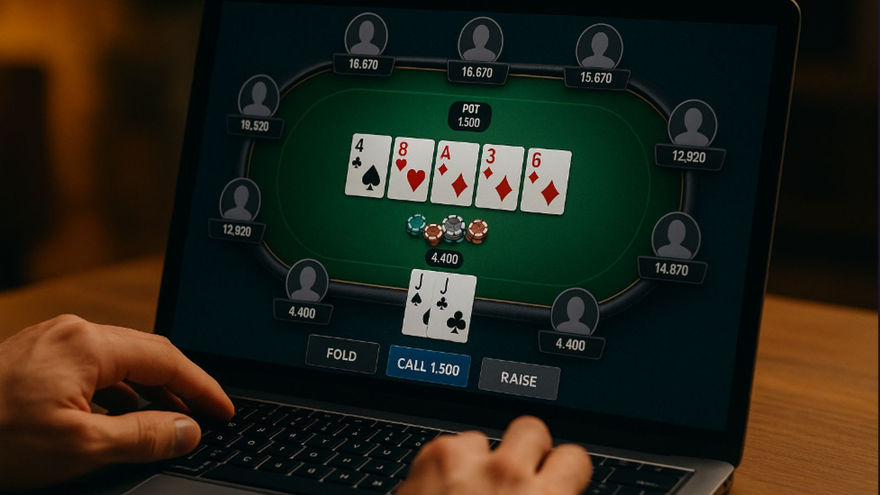
Online poker has never stood still, but 2025 marks a clear shift in how players think, study, and execute strategy. The modern player faces a different environment than the one that shaped the early grinders of the 2010s. Games run faster, pools move dynamically between platforms, and tools available to amateurs now rival what high-stakes regulars used a few years ago. To stay competitive, players need more than a solid preflop chart; they need adaptability, range awareness, and a realistic grip on how the ecosystem works today.
This article breaks down the key strategic changes shaping online poker in 2025 and why the players who thrive are the ones who constantly refine how they learn, measure risk, and make decisions.
Sharper Preflop Precision Driven by Modern Solvers
Solver use is no longer a secret weapon; it’s baseline preparation. What changed in 2025 is how players apply solver data. Instead of memorising entire charts, the modern grinder focuses on principles. Understanding why a hand mixes between raise and call at certain stack depths helps players adjust when pool tendencies drift from theory.
Several notable trends define this year’s preflop evolution:
More aggressive 3-betting frequencies at mid-stakes due to wider population opens.
Refined short-stack strategies, such as fast-fold and jackpot formats, push shallower play.
Greater emphasis on exploit lines against opponents who lean heavily on solver-approved but predictable lines.
Players who treat solvers as study partners, not commandments, are getting a clear edge.
Postflop Strategy Shifts: Less Guesswork, More Patterns
The speed of modern online poker demands efficient thinking. Regulars are increasingly leaning on pattern recognition rather than deep node-by-node calculations. In practice, that means:
C-betting less frequently on boards that heavily favour the caller’s range.
Applying heavier turn probes when the opponent’s range caps early.
Using smaller bet sizes in multiway pots to keep ranges wide and avoid bloating uneven equity spots.
The strongest players in 2025 aren’t the ones who know every exact combo count; they’re the ones who instantly spot board structures where population errors pile up.

A Safer, More Professional Approach to Bankroll Management
Bankroll management has always been part of poker strategy, but online volatility in 2025 makes it essential. With jackpot SNGs, fast-fold formats, and higher-rake micro games, swings are bigger. Players are adjusting by:
Moving down faster after sudden downswings.
Keeping shot-taking structured, using fixed rules rather than emotion.
Balancing poker volume with low-risk casino side play to smooth variance.
This last point is new. Many players build small buffers by mixing in low-volatility games or promotional offers available on gaming platforms. In discussions around optional add-ons or cross-platform bonuses, some players even reference sites like Aussie Casino as examples of where casual players combine poker and other casino games. While such add-ons aren’t part of the core strategy, the mindset behind them, stability over ego, reflects the direction of modern bankroll theory.
Rise of Multi-Format Players
The stereotype of the single-format specialist is fading. Online players now treat game formats as complementary training grounds:
Cash games sharpen hand reading and range building.
MTTs teach survival strategy and high-pressure decision-making.
Spin formats refine push-fold play and short-stack accuracy.
Fast-fold forces rapid pattern recognition and pool-level adjustments.
Players who shift across these arenas gain a broader strategic view and adapt better when sitting with unpredictable opponents.
Game Selection Is Becoming Strategy, Not an Afterthought
Choosing where to play matters more than ever. Pool strength varies widely by region, time of day, and format. The strongest regulars in 2025 track:
Table occupancy patterns
Average pot size per table
Regular-to-recreational ratios
Differences in player behaviour on mobile vs desktop
This isn’t game selection as a luxury; it's part of a winning strategy. A player using near-perfect ranges on the wrong site still loses. A player using good-enough ranges on a softer pool wins.
Psychological Stability Is the New Edge
Tilt control used to be about quitting on time. Today it’s about maintaining clear decision-making through more intense session structures. Short-stack formats, rapid-fire queues, and swing-heavy environments reward players with stable emotional patterns.
The best grinders in 2025:
Use shorter session blocks
Review marked hands immediately after play
Track emotional markers like frustration spikes
Reduce multitabling when losing focus
Approach study the way athletes treat training days
Mental strength is no longer an intangible skill; it's part of a player’s measurable strategy.
A More Realistic View of GTO vs Exploit Play
One of the most important shifts this year is how players view “optimal” poker. Instead of choosing between strict GTO and pure exploit, strong players blend both:
Use GTO baselines to avoid obvious leaks
Apply exploits where population errors are consistent
Anchor decisions in range theory while adjusting for player type
Break away from solver lines when the pool folds too often or calls too light
Make smaller deviations that accumulate EV without creating counter-exploitable tendencies
This middle path reflects a more mature understanding of how real online poker works: theory matters, but results come from analysing opponents, not beating a simulation.
Tools Have Improved, But Interpretation Matters More Than Ever
Poker software is stronger than at any point in online history. But tools don’t guarantee improvement; interpretation does. In 2025, the grinders pulling ahead are the ones who:
Use solvers to identify trends, not perfect lines
Review databases to spot their own recurring mistakes
Track population data to find consistent leaks
Build strategies around real-player behaviour, not laboratory conditions
A tool can show you the answer. A player still has to understand why the answer works.
Final Takeaway: Flexibility Wins 2025
Poker strategy in 2025 is defined by adaptability. The days of rigid lines and memorised charts are fading. What matters now is fluidity — shifting gears based on opponent type, format, stack depth, and ecosystem trends.
Players who grow in this environment don’t just study ranges. They study themselves, the player pool, and the constantly changing landscape of online games.
And those who embrace this evolving model — with disciplined bankroll habits, a broader mindset, and a strategic blend of theory and exploit — are the ones shaping the future of online poker.